
Rose Hair Tarantula
Grammostola rosea
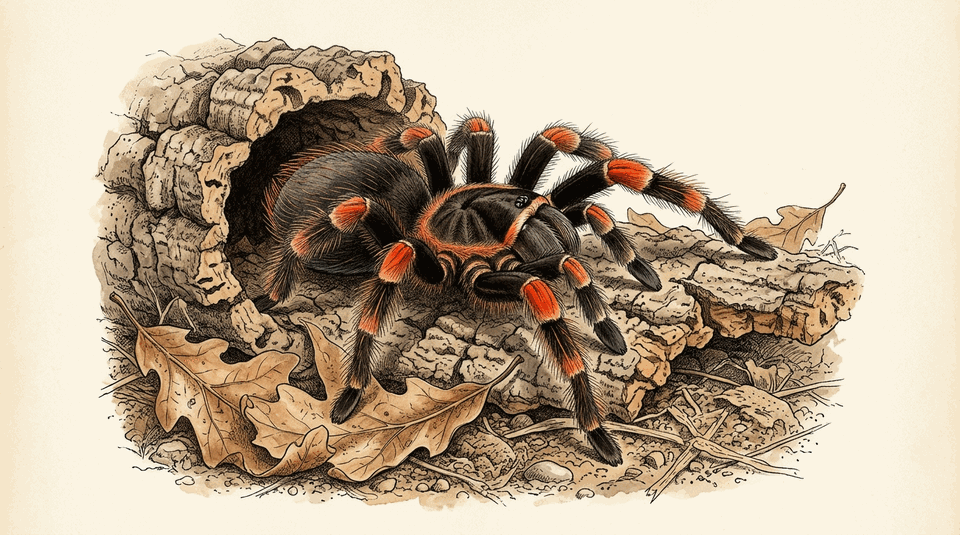

1. Deep Soil & Low-Ceiling Safety Setup

2. Two Great Ways to Set Up Your Habitat
Sizing the Tank: Slings vs. Adults
Putting a fingernail-sized baby ('sling') in a giant 10-gallon tank makes it impossible for them to find dinner:
Option A: Spiderlings ('Slings' Under 1.5")
Keep in a vented sling vial or micro acrylic cube (about 3–4× their legspan wide) with 2" of soil, a piece of moss, and a clean tattoo-ink cap or bottlecap for water.
Option B: Juveniles & Adults (2" to 7"+)
A 5- to 10-gallon glass or acrylic enclosure filled halfway up with 4–6" of packed reptile/invertebrate soil and a curved cork bark starter cave.
Ground Burrowers vs. Tree Climbers
Make sure your setup matches where your spider actually lives in nature:
Option A: Ground / Burrowing (Curly Hair, Red Knee, Arizona Blonde)
Wide floor space, deep 4–6" soil for bulldozing, and low ceiling clearance so a clumsy climber can never take a big fall.
Option B: Tree-Dwelling (Pinktoes, Versicolor, Jumping Spiders)
Tall enclosure with lots of side-wall air holes (cross-ventilation!) and tall cork bark reaching near the ceiling.
To Handle or Not to Handle?
Real talk from our invert team: tarantulas don't get cuddly from being held—handling is mostly for us:
Option A: Hands-Off Display Pet (What We Recommend)
Safest for the spider! Use a soft paintbrush to gently tap their back legs and guide them into a catch-cup whenever you need to clean.
Option B: Sit Flat on the Floor (Calm Docile Species Only)
If you do let a calm Curly Hair or Red Knee walk on your open palm, sit on the floor or bed so a sudden bolt can never mean a fatal drop to the floor.

3. Feeding by 'Booty Size' & The Molting Rule
Best Bugs & Big No-Nos:
Top pick—nutritious and won't bite a spider!
Great hunters—MUST remove uneaten crickets after 24h!
Crush worm heads so they can't hide underground
Wild bugs carry lawn sprays & parasites that kill spiders

4. Four Keys to a Happy, Thriving Rose Hair Tarantula
Watch Out for Wire Mesh
Heavy ground tarantulas have two tiny hooks on each foot that can get snagged in cheap woven window-screen lids. Acrylic lids with drilled air holes are way safer!
Overflow the Water Dish
Tarantulas hate being sprayed in the face with a mister! Instead, just overfill their water dish a little bit once a week so one corner of the soil stays damp.
Itchy Belly Hairs
New World tarantulas kick itchy 'urticating hairs' off their butt when annoyed. Don't rub your eyes after working in the tank, and wash your hands with soap!
Upside-Down vs. Death Curl
Flat on their back = happy molting! Right-side-up with all 8 legs curled tightly *underneath* the belly = dehydrated ('death curl')—put their mouthparts right into a shallow puddle of water!

Bring-Home Shopping Checklist
Tap items to check them off on your phone while you shop at Critter Cabana.
Enclosure & Deep Soil
Water Dish & Safe Tools
Live Feeder Bugs
Complete Reference Notes & Oregon Keeping Guide
Species: Grammostola rosea (and G. porteri) | Difficulty: 1/5 — Beginner | Hardiness: 5/5 — Bulletproof
Critter Cabana & Gresham Pet Supply — Keeping Your Pet Healthy & Thriving
At a Glance
| Common Name | Rose Hair Tarantula, Chilean Rose | |
| Species | Grammostola rosea | |
| Origin | Arid deserts and scrublands of Chile | |
| Adult Size | 5–6 inch leg span (Heavy-bodied terrestrial) | |
| Lifespan | Females: 20–30+ years | Males: 4–5 years |
| Diet Type | Insectivore (Crickets, Roaches, Mealworms) | |
| Activity | Nocturnal (Very slow, inactive spider that often sits out in the open) | |
| Temperament | Generally docile and slow-moving, though they are known to have occasional grumpy "mood swings." | |
| Handleability | Good. They are one of the most commonly handled tarantulas, though caution should still be used. | |
| Venom | Medically insignificant (Comparable to a bee sting, unless allergic) | |
| Urticating Hairs | Yes (They can flick mildly irritating hairs from their abdomen if stressed) | |
| Difficulty | 1/5 — Beginner (The ultimate classic beginner tarantula) | |
| Hardiness | 5/5 — Bulletproof (Incredibly forgiving of husbandry mistakes, provided they are kept dry) |
Why We Love Them: For decades, the Rose Hair Tarantula has been the undisputed gateway into the tarantula hobby. They are incredibly hardy, very slow-moving, and live for decades. Their fuzzy, metallic-pink carapace and calm demeanor make them the perfect "pet rock" for someone looking for a low-maintenance exotic pet.
Notable Morphs & Locales
While the standard Rose Hair (Grammostola porteri) is mostly grey-brown with a subtle pinkish carapace, the Red Color Form (often sold as **Grammostola rosea "Red"**) is a highly sought-after morph.
- The "Red" Morph: This variant features a brilliant, fiery copper/red hue across its entire body and legs, rather than just the carapace. Their care is completely identical to the standard grey/pink form, but they are visually stunning.
Safety Information
Venom/Defense: Their venom is medically insignificant. Their primary defense is kicking urticating hairs from their abdomen. While these hairs are mild compared to other species, they are still itchy.
Handling Precautions: While they are famous for being handleable, all tarantulas are fragile. Because they are heavy-bodied terrestrials, a fall from a human hand to a hard floor will rupture their abdomen and kill them instantly. If you must handle them, always sit on the floor or hold them directly over a soft surface (like a bed).

Housing & Enclosure
Enclosure Type & Size
- Type: Terrestrial / Ground Dweller.
- Minimum: A 5-gallon to 10-gallon glass aquarium or an Exo Terra Low (18x18x12) is perfect for an adult.
- The Height Warning (CRITICAL): You must prioritize floor space over vertical height. If the enclosure is too tall, you must fill it with deep substrate so the distance from the dirt to the ceiling is no more than 1.5x the spider's leg span. A fall from the ceiling is fatal.
Substrate
- Recommended: Coconut fiber (Eco Earth), peat moss, or organic topsoil.
- Depth: Provide 4 to 5 inches of substrate. They will occasionally dig small starter burrows, and the deep soil cushions them if they climb.
- Moisture: KEEP IT DRY. Rose Hairs come from the arid scrublands of Chile. They hate wet feet and will climb the glass to escape damp soil, increasing their risk of a fatal fall.
Décor & Enrichment
- Hides: Provide a curved cork bark hide or half-log.
- Water Dish: Provide a shallow water dish. Keep it filled with fresh water at all times. Do not put sponges in the water; tarantulas cannot drink from sponges and they harbor bacteria.
Temperature
| Zone | Temperature |
|---|---|
| Ambient | 70–80°F (21–27°C) |
- Heating: Room temperature is perfect. If you are comfortable in a t-shirt, your Rose Hair is comfortable. Never use a heat lamp.
Humidity
- Target Range: 40–60% (Low-Moderate).
- How to Maintain: Do not mist the enclosure. The only moisture they need comes from their water dish and their food. Keep the substrate bone dry.
Diet & Nutrition
The "Fasting" Warning (CRITICAL)
Rose Hairs are infamous in the hobby for going on massive hunger strikes. It is completely normal for a healthy adult Rose Hair to refuse food for 6 to 12 months at a time. If their abdomen is plump and they are refusing food, do not panic. Simply remove the crickets, ensure they have fresh water, and try again in a few weeks.
Primary Diet
- Live crickets, dubia roaches, or mealworms. Ensure the prey is smaller than the spider's abdomen.
Feeding Schedule
| Life Stage | Frequency | Prey Size |
|---|---|---|
| Spiderling (Sling) | Every 5–7 days | Pinhead crickets or small mealworms |
| Juvenile | Every 7–10 days | Medium crickets |
| Adult | Every 2–4 weeks | 2-3 Large crickets or 1 Large Roach |
Molting
During the Molt
- DO NOT disturb the spider. It will flip on its back to molt. It is not dead. Do not flip it over.
- Remove any live crickets from the enclosure immediately. A live cricket will eat a molting tarantula alive.
Post-Molt Care
- Wait at least 10–14 days before offering food. Because they are heavy-bodied, it takes a long time for their new fangs to harden. If they bite a cricket too soon, their fangs will break off and they will starve to death.
What We Stock & Use in Our Stores
These are products we carry and recommend for this species. Ask any associate for help finding them in-store.
| Category | Product | Notes |
|---|---|---|
| Enclosure | Aqueon 10-Gallon Tank | Prioritize floor space over height |
| Substrate | Zoo Med Eco Earth (Coco Fiber) | Use completely dry |
| Hides | Zoo Med Natural Cork Bark (Curved) | The perfect starting roof for their hide |
| Tools | Zoo Med 10-inch Feeding Tongs | Highly recommended for safe maintenance |
| Water Dish | Exo Terra Shallow Water Dish (Medium) | Provide fresh water, no sponges |
Care sheet compiled by Critter Cabana & Gresham Pet Supply. For questions, ask any livestock specialist in-store.
Last updated: 2026-08-04
How We Keep Them at Critter Cabana & Gresham Pet Supply
- Oregon Winter Furnace Air vs. Molting Humidity: When Pacific Northwest furnaces kick on from October through April, indoor room humidity drops fast and dries out small enclosures from the top down. Rather than misting the spider or invert directly (which stresses terrestrial species and invites stagnant mold), we keep Rose Hair Tarantula at
40-60% (Low-Moderate)by using a deep moisture-retaining substrate bed (ReptiSoil + Coco Fiber + Sphagnum Moss), overflowing the water dish slightly into one corner, and maintaining cross-ventilation. - Safe Room Heating in the Willamette Valley: If your house drops below 65°F on winter nights, never stick a heat pad on the bottom of a burrowing invertebrate tank—they dig down to escape heat and will cook themselves. Use a low-wattage side-mounted heat mat on a digital thermostat or warm the room ambiently to
species-appropriate warm zone. - Stocked at Newberg & Gresham: At Critter Cabana (Newberg) and Gresham Pet Supply, we stock acrylic and glass invertebrate enclosures, cork bark flats and tubes, bioactive substrates, flightless fruit flies (D. melanogaster and D. hydei), pinhead to adult crickets, dubia roaches, and live Temperate White Springtail and Isopod cultures.
Common Questions (FAQ)
How do I keep my Rose Hair Tarantula warm and humid enough during an Oregon winter?
Target species-appropriate warm zone and 40-60% (Low-Moderate). When Oregon winter furnaces dry out the air, use a deep 3–5 inch substrate mix of Zoo Med ReptiSoil and coco fiber, keep a shallow water dish filled, and dampen one corner of the substrate rather than misting the animal directly. Never put a heat mat underneath a burrowing invertebrate enclosure.
What size enclosure does a Rose Hair Tarantula need?
An adult Rose Hair Tarantula thrives in 5 to 10-Gallon Tank with secure ventilation. For terrestrial tarantulas and scorpions, floor space and deep substrate matter most (keep open fall height low so heavy-bodied species cannot rupture their abdomen); for arboreal species, prioritize vertical cork bark tubes and cross-ventilation.
Can I put isopods in a Rose Hair Tarantula bioactive enclosure?
Around molting tarantulas and scorpions, skip protein-hungry large isopods and stick to Temperate White Springtails (or gentle Dwarf White isopods in humid detritivore setups) so a soft, newly molted animal is never nibbled.
Where can I find Rose Hair Tarantula, cork bark, and feeder insects in Oregon?
We stock live invertebrates, tarantulas, jumping spiders, cork bark flats and tubes, bioactive substrates, and gut-loaded feeder insects at our two exotic animal stores: Critter Cabana in Newberg (514 E First St, 503-537-2887) and Gresham Pet Supply (2185 NW Burnside Rd, 503-665-7606).