
Syrian Hamster
Mesocricetus auratus

1. Deep-Burrowing Terrarium & 10–12" Solid Wheel Setup
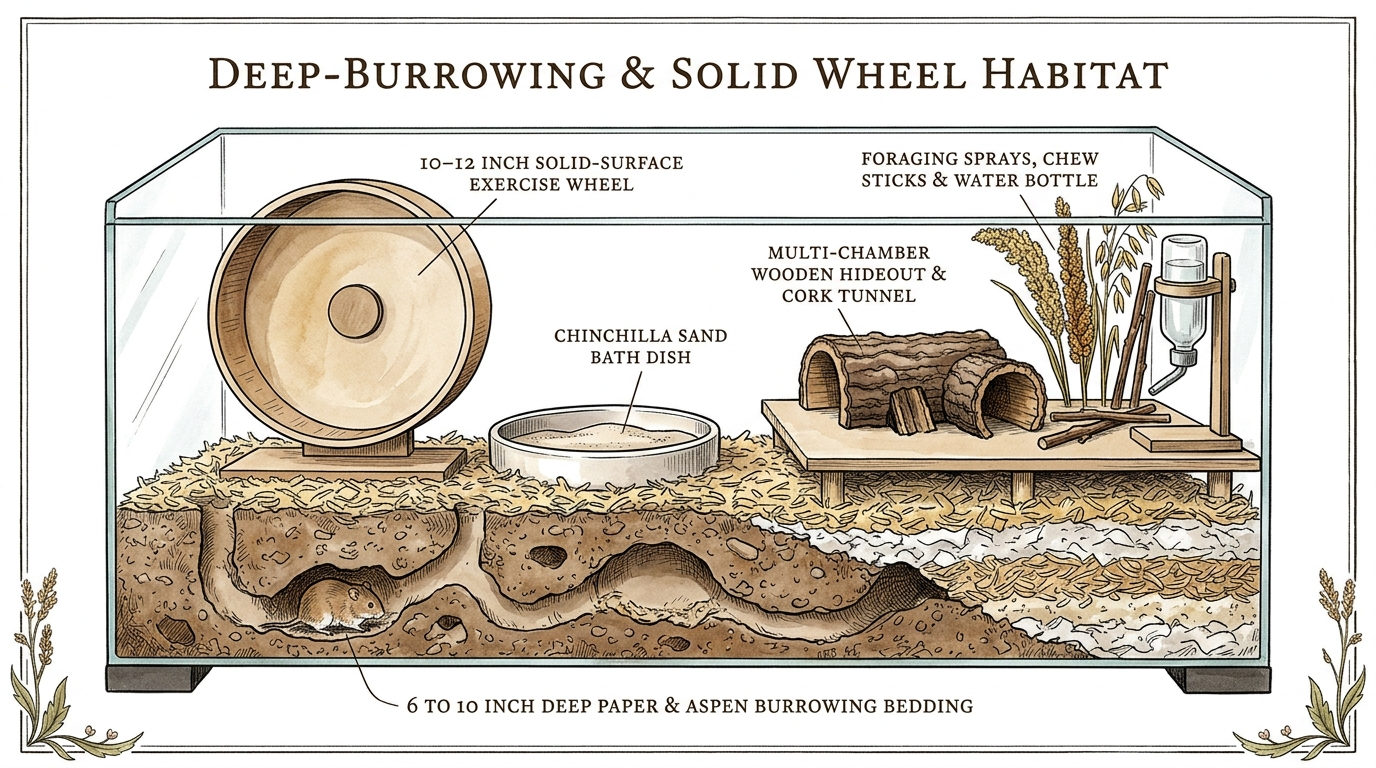

2. Two Great Ways to Set Up Your Habitat
Enclosure: 40-Gallon Breeder Glass Tank vs. Modular Plastic Tube Cages
Skip tiny colorful tube cages! They only offer ~250 sq in, cannot hold deep bedding, and cause hamsters to chew bars all night:
Option A: 40-Gallon Breeder Tank (36×18") + Locking Screen Lid (Our Top Pick!)
Gives 648+ sq in of unbroken floor space, holds 8–10 inches of deep burrowing bedding without kicking it onto your floor, and fits a 12" wheel easily!
Option B: Large Deep-Base Front-Opening Terrarium (800+ Sq In)
Zero wire bars to chew (preventing broken teeth and nose rubs) with crystal-clear viewing of their underground tunnel system.
Burrowing Bedding Mix & Chinchilla Sand Bath
Never bathe a hamster in water! Water strips their protective coat oils and causes fatal hypothermia:
Option A: 70% Carefresh / Clean & Cozy Paper + 30% Aspen Shavings + Orchard Hay
Layering soft paper bedding with dust-extracted aspen and a handful of soft hay acts like 'rebar' so their underground bedrooms never collapse!
Option B: Permanent Ceramic Chinchilla Sand Bath Dish
Fill a heavy ceramic dish with Reptisand or Chinchilla Bath Sand (use sand, not fine airborne dust!). They roll in it nightly to stay clean and often use it as a litter box!
The 10–12" Solid Wheel & Solitary Housing Law
Syrian hamsters are fiercely territorial desert loners:
Option A: 10–12" Solid-Surface Upright Wheel (Silent Spinner / Niteangel Style)
A 6–8" wheel forces an adult Syrian to arch its spine into a painful 'U' shape. Always pick a 10" to 12" solid-surface upright wheel (never wire mesh!).
Option B: Strictly One Hamster Per Enclosure
Once Syrian hamsters hit 6–8 weeks old, housing two together will result in fatal fights—even littermates. One hamster per tank is the golden rule.

3. Omnivore Foraging Diet & Hoard Management
Scatter-Feeding & Cheek Pouch Rules:
Sprinkle seeds across the bedding so they forage for hours
Stashing food in their bed is normal! Only remove wet/spoiled fresh food
Tuck millet, oat, and flax sprays into the bedding
Citrus, onion, garlic, chocolate, almonds, or sticky sugary treats

4. Four Keys to a Happy, Thriving Syrian Hamster
Let Sleeping Hamsters Sleep
Syrians sleep deeply all day and wake up around dusk. Waking a sleeping hamster startles them and is the #1 cause of defensive nips—wait until they're up and exploring in the evening!
Spot-Clean, Don't Strip-Clean!
Replacing 100% of the bedding at once erases all their scent marks and stresses them out! Spot-clean the pee corner and sand bath every few days, and only replace 1/3 of the deep bedding per month.
Skip Exercise Balls & Cotton Fluff
Plastic run-about balls have poor ventilation, trap toes in air slits, and blind a hamster's whiskers. Also skip 'fluffy cotton' nesting material, which tangles around legs and pouches.
Check for Cold Torpor
If an Oregon winter night drops their room below 60°F, a hamster can slip into cold torpor—looking limp and barely breathing. Warm them slowly in your hands and keep the room 65°–75°F.

Bring-Home Shopping Checklist
Tap items to check them off on your phone while you shop at Critter Cabana.
40B Tank & Deep Bedding
10–12" Wheel, Sand Bath & Chews
Food & Hydration
Complete Reference Notes & Oregon Keeping Guide
Species: Mesocricetus auratus | Difficulty: 1/5 — Beginner | Hardiness: 4/5 — Hardy
Critter Cabana & Gresham Pet Supply — Keeping Your Pet Healthy & Thriving
At a Glance
| Common Name | Syrian Hamster, "Teddy Bear" Hamster, Golden Hamster |
| Species | Mesocricetus auratus |
| Origin | Arid regions of Syria and the Middle East |
| Adult Size | 6–8 inches (The largest domestic hamster) |
| Weight | 120–200 grams |
| Lifespan | 2–3 years |
| Diet Type | Omnivore (Seeds, Grains, Vegetables, Insects) |
| Activity | Nocturnal (sleeps all day, wakes up late in the evening) |
| Temperament | Docile, slow-moving, and very easy to handle. |
| Handleability | Excellent. They are much slower and chunkier than Dwarf hamsters. |
| Social Needs | Strictly Solitary. |
| Odor Level | Low (if the enclosure is spot-cleaned regularly) |
| Difficulty | 1/5 — Beginner (The ultimate classic first pet) |
| Hardiness | 4/5 — Hardy (Except for the risk of "Wet Tail" in babies) |
Why We Love Them: The Syrian Hamster is the classic "first pet." They are large, slow, and much easier for children to hold safely than mice or dwarf hamsters. Because they sleep during the day, they are perfect for people who work or go to school and want a pet to interact with in the evening.
Notable Breeds & Varieties
All domestic Syrian hamsters are exactly the same species, but they are often sold under confusing marketing names based on their fur type:
- "Teddy Bear" Hamster: This is just a long-haired Syrian hamster. Males get spectacular "skirts" of long fur, while females usually just look slightly fluffy.
- "Black Bear" Hamster: A marketing term for a solid black, short-haired Syrian.
- Short-Haired / Golden: The standard, wild-type fur coat.
Housing & Enclosure
Enclosure Size (The Space Warning)
- Minimum: 900+ square inches of continuous floor space (a 40-gallon breeder aquarium is the absolute minimum).
- Female Syrians: Female Syrians are notoriously demanding of space and often display stress behaviors (like bar-chewing or wall-surfing) even in 40-gallon tanks. If buying a female, be prepared to upgrade to an even larger enclosure (like a 75-gallon tank or large DIY bin cage).
- Enclosure Recommendations: Do not use small, modular plastic tube cages (like CritterTrails). Syrian hamsters will get physically stuck in the tubes and suffocate.
Bedding & Substrate
- Depth (CRITICAL): Hamsters are burrowing animals. You must provide a minimum of 8 to 10 inches of deep bedding so they can build massive tunnel systems.
- Recommended: Unscented paper bedding (Carefresh, Kaytee Clean & Cozy) or Aspen shavings.
- Avoid: Cedar shavings (highly toxic) and pine shavings.
- Cleaning Schedule: Spot clean the soiled corner (they usually pick one corner to pee in) every 2-3 days. Do a 50% bedding change every 3-4 weeks. Never change 100% of the bedding, as it causes massive stress.
Décor & Enrichment
- The Wheel (CRITICAL): A Syrian hamster requires a 10-inch to 12-inch solid-surface wheel. If the wheel is too small, their back will bend like a "U", causing permanent, painful spinal damage. Never use wire or mesh wheels (causes "Bumblefoot").
- Hideouts/Huts: Provide large wooden houses or multi-chamber hides.
- Sand Bath: Provide a large dish filled with ReptiSand (pure quartz desert sand without calcium or dyes) for them to clean their fur. Do not use chinchilla dust.
Diet & Nutrition
Unlike Dwarf hamsters, Syrians are not highly prone to diabetes, meaning they can enjoy a wider variety of fresh fruits!
Primary Diet
- High-Quality Seed Mix: Feed a high-variety seed and grain mix (like Higgins Sunburst) mixed 50/50 with a high-protein lab block (like Mazuri Rat & Mouse or Oxbow).
- Feeding Amount: 1.5 to 2 tablespoons per day. Scatter-feed the food by sprinkling it around the cage to encourage natural foraging.
Fresh Vegetables & Fruits
- Safe Veggies: Broccoli, cucumber, zucchini, spinach, carrots, and sweet potato.
- Safe Fruits (Treats): Apples (no seeds), bananas, blueberries, and strawberries.
- Frequency: A piece the size of the hamster's ear, offered 3-4 times a week.
Treats
- Safe Treats: Mealworms (dried or live), plain unflavored oats, or commercial yogurt drops (in strict moderation).
Handling & Behavior
Taming & Handling
- Always wash your hands before handling; if you smell like food, they may give you a test nibble.
- Never wake a sleeping hamster. If you dig them out of their burrow during the day, they will likely bite you out of fear. Wait until they wake up in the evening.
Social Needs (The Solitary Rule)
- Strictly Solitary: Syrian hamsters are fiercely territorial. If you put two Syrian hamsters in the same cage, they will fight to the death. They do not get lonely. They must live alone.
Health & Husbandry

Common Health Issues
- Wet Tail (Proliferative Ileitis) — Symptoms: Severe, watery diarrhea, lethargy, hunched posture, and a wet/soiled tail. / Cause: Extreme stress (usually from moving to a new home) causing a severe bacterial infection in the gut. Extremely common in very young Syrians. / Treatment: Highly fatal (within 48 hours). Requires immediate emergency exotic vet care and antibiotics. Over-the-counter "Wet Tail Drops" do not work.
- Overgrown Teeth — Symptoms: Inability to eat, drooling. / Cause: Lack of wooden chew toys. / Treatment: Requires a vet to trim the teeth.
- Mites — Symptoms: Intense scratching, thinning fur. / Cause: Often brought in on cheap bedding or hay. / Treatment: Vet-prescribed topical medication.
What We Stock & Use in Our Stores
These are products we carry and recommend for this species. Ask any associate for help finding them in-store.
| Category | Product | Notes |
|---|---|---|
| Enclosure | Aqueon 40-Gallon Breeder Aquarium + Screen Lid | The absolute minimum size required for a Syrian |
| Bedding | Carefresh Unscented Paper Bedding | Holds massive burrows. Fill at least 8+ inches deep! |
| Food | Higgins Sunburst Gourmet Blend + Mazuri Rat & Mouse Diet | Mix these 50/50 for a balanced diet |
| Wheel | Exotic Nutrition Silent Runner (12-inch) | Must be 10-12 inches to protect their spine |
| Sand Bath | Zoo Med ReptiSand (Natural Red or White) | Safe, dust-free sand for bathing. Never use calcium sand. |
| Chew Toys | Oxbow Enriched Life Apple Sticks & Willow Balls | Essential for keeping front teeth trimmed |
Care sheet compiled by Critter Cabana & Gresham Pet Supply. For questions, ask any livestock specialist in-store.
Last updated: 2026-08-04
How We Keep Them at Critter Cabana & Gresham Pet Supply
- Pacific Northwest Seasonal Drafts & Indoor Air Quality: In Oregon, damp chilly winters and sudden August heatwaves are the two biggest environmental stressors for Syrian Hamster. Keep their habitat (
900+ square inches (40-gallon breeder minimum)) away from drafty windows, exterior doors, and direct furnace vents, and maintain a steadyspecies-appropriate warm zonetemperature zone. - What Our Store Crew Uses Daily: In our Newberg and Gresham animal rooms, we use dust-extracted, scent-free bedding (never cedar or raw phenols), fresh Pacific Northwest grass hays or species-specific pelleted staples (Oxbow, Harrison's, Roudybush, or Higgins), and daily foraging enrichment so young animals are already hand-accustomed and eating a balanced diet before they go home with you.
- Local Exotic Vet Planning: Before an emergency ever happens, save the number of an experienced Oregon avian/exotic veterinarian in the Portland Metro or Willamette Valley area (such as Avian & Exotic Veterinary Care or Scales & Tails Exotic Pet Clinic).
Common Questions (FAQ)
What size cage or habitat does a Syrian Hamster actually need?
Plan on at least 900+ square inches (40-gallon breeder minimum) as a true minimum—bigger horizontal floor space (or flight width for birds) is always better for daily exercise, mental health, and clean air quality.
How do I keep Syrian Hamster comfortable through Oregon winters and summers?
Keep indoor temperatures steady around species-appropriate warm zone with balanced humidity humidity, well away from cold window drafts in winter and direct afternoon sun in summer.
What do you feed Syrian Hamster at Critter Cabana and Gresham Pet Supply?
Our store crew feeds a balanced omnivore regimen built on high-quality pellets/hay and daily fresh produce or foraging items—never all-seed junk mixes that cause vitamin deficiencies and fatty liver disease.
Where can I meet Syrian Hamster and talk to the animal care crew in Oregon?
Visit our live animal departments at Critter Cabana in Newberg (514 E First St, 503-537-2887) or Gresham Pet Supply (2185 NW Burnside Rd, 503-665-7606) to meet our animals and get hands-on setup advice.