
Italian Ladybird Spider
Eresus ruficapillus
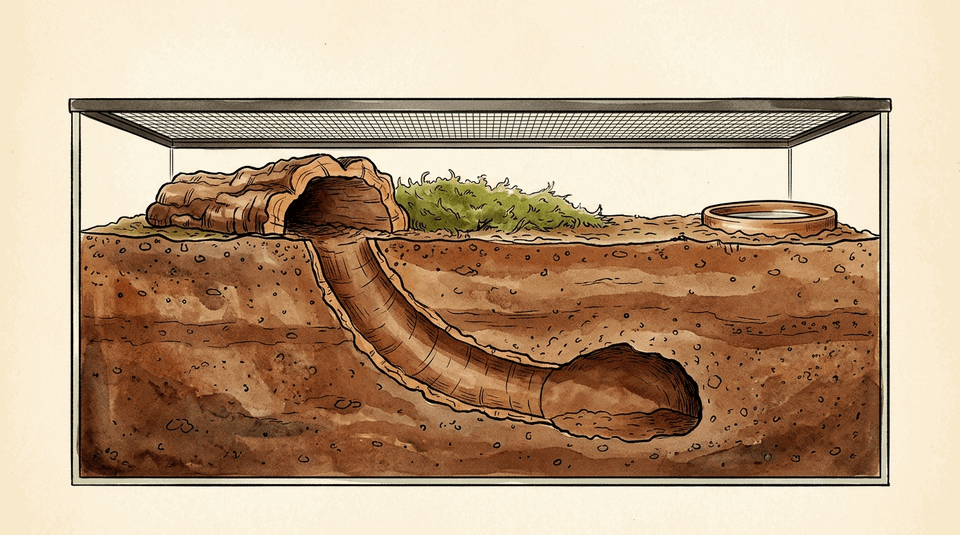
1. Habitat Layout & Temperature Gradient
Species: Eresus ruficapillus (Velvet Spider) | Difficulty: 2/5 — Easy | Hardiness: 2/5 — Delicate (Extremely sensitive to moisture)

Critter Cabana & Gresham Pet Supply — Keeping Your Pet Healthy & Thriving
At a Glance

| Common Name | Italian Ladybird Spider, Italian Velvet Spider | |
| Species | Eresus ruficapillus | |
| Origin | Dry, sandy, and arid regions of Italy and Southern Europe | |
| Adult Size | Very Small: Females reach 0.6 inches, Males are even smaller | |
| Lifespan | Females: 3–5 years | Males: ~1 year |
| Diet Type | Insectivore (Fruit flies, small crickets) | |
| Activity | Secretive (Spends most of its time hidden in a heavy silk tube burrow) | |
| Temperament | Reclusive and docile. They are ambush predators that rely on vibrational sensing rather than sight. | |
| Handleability | Do not handle. They are incredibly tiny and fragile. A slight squeeze or short fall is fatal. | |
| Venom | Medically insignificant | |
| Urticating Hairs | None | |
| Difficulty | 2/5 — Easy (Care is very simple, as long as you follow the "bone dry" rule) | |
| Hardiness | 2/5 — Delicate (Extremely sensitive to humidity; moisture is fatal) |
Why We Love Them: Velvet spiders are absolutely adorable! They are tiny, fuzzy, and look almost like a plush toy or a large jumping spider. The males of this species feature a striking red-and-black pattern on their abdomen that perfectly mimics a ladybird (ladybug). While they are very secretive and you may not see them often, feeding them is highly entertaining as they ambush prey from their silk tunnels!
Safety & Husbandry Warnings (CRITICAL)

The "Bone Dry" Rule: This is an arid species that comes from hot, dry environments. Moisture is fatal. You must NEVER mist the enclosure. You must NEVER provide a water dish. They get 100% of the moisture they need to survive directly from the juices of the bugs they eat. If the air in their enclosure becomes humid or stagnant, they will quickly succumb to fungal infections and die. Keep them bone dry with high cross-ventilation.
Housing & Enclosure
Enclosure Type & Size
- Type: Terrestrial / Heavy Webber.
- Minimum: Because they are incredibly small, they do not need—and should not have—a large enclosure. A small 4x4x6 inch acrylic enclosure (such as a Tarantula Cribs sling box or a deli cup with ventilation holes) is more than enough for a full-grown adult.
- Ventilation: Excellent cross-ventilation is critical to prevent stagnant air.
Substrate
- Recommended: Dry organic topsoil, dry coconut fiber, or a sand/soil mix.
- Depth: Provide 1.5 to 2 inches of substrate. They will dig a small starter burrow and heavily line it with thick, white silk.
- Moisture: 100% Bone Dry. Never add water.
Décor & Enrichment
- Anchor Points: Provide a very small piece of cork bark or a small twig on top of the soil. This gives them an anchor point to attach their silk tubes to.
Temperature
| Zone | Temperature |
|---|---|
| Ambient | 72–82°F (22–28°C) |
- Heating: Room temperature is perfect. Never use a heat lamp or heat pad on such a small enclosure, as it will quickly bake the tiny spider.
Diet & Nutrition

They are ambush predators. They will sit just inside the entrance of their silk tube and wait for a bug to walk over their trip-lines.
Primary Diet
- Flightless fruit flies (for spiderlings), pinhead crickets, or extra-small mealworms.
Feeding Schedule
| Life Stage | Frequency | Prey Size |
|---|---|---|
| Spiderling (Sling) | Every 4–5 days | Drosophila melanogaster (Fruit Flies) |
| Adult | Every 7–10 days | 1-2 Pinhead or Small Crickets |
- Maintenance: Remove any uneaten prey after 24 hours. A live cricket left in a tiny enclosure can stress or injure the spider.
Molting
During the Molt
- They will seal themselves entirely inside their silk tube to molt.
- DO NOT disturb the silk tube, tear it open, or try to check on them. They will emerge when they are ready.
- Remove any live feeder insects immediately.
What We Stock & Use in Our Stores
These are products we carry and recommend for this species. Ask any associate for help finding them in-store.
| Category | Product | Notes |
|---|---|---|
| Enclosure | Zilla Micro Habitat (Terrestrial Small) | Perfect size and excellent cross-ventilation |
| Substrate | Zoo Med ReptiSand / Eco Earth Mix | Keep 100% dry at all times |
| Anchor Points | Zoo Med Natural Cork Bark (Small Chips) | Gives them a place to attach their silk tube |
| Tools | Exo Terra Fine Tongs | Necessary for precisely dropping in tiny feeder insects |
Care sheet compiled by Critter Cabana & Gresham Pet Supply. For questions, ask any livestock specialist in-store.
Last updated: 2026-08-04
How We Keep Them at Critter Cabana & Gresham Pet Supply
- Oregon Winter Furnace Air vs. Molting Humidity: When Pacific Northwest furnaces kick on from October through April, indoor room humidity drops fast and dries out small enclosures from the top down. Rather than misting the spider or invert directly (which stresses terrestrial species and invites stagnant mold), we keep Italian Ladybird Spider at
Bone Dry (Do not mist)by using a deep moisture-retaining substrate bed (ReptiSoil + Coco Fiber + Sphagnum Moss), overflowing the water dish slightly into one corner, and maintaining cross-ventilation. - Safe Room Heating in the Willamette Valley: If your house drops below 65°F on winter nights, never stick a heat pad on the bottom of a burrowing invertebrate tank—they dig down to escape heat and will cook themselves. Use a low-wattage side-mounted heat mat on a digital thermostat or warm the room ambiently to
species-appropriate warm zone. - Stocked at Newberg & Gresham: At Critter Cabana (Newberg) and Gresham Pet Supply, we stock acrylic and glass invertebrate enclosures, cork bark flats and tubes, bioactive substrates, flightless fruit flies (D. melanogaster and D. hydei), pinhead to adult crickets, dubia roaches, and live Temperate White Springtail and Isopod cultures.
Common Questions (FAQ)
How do I keep my Italian Ladybird Spider warm and humid enough during an Oregon winter?
Target species-appropriate warm zone and Bone Dry (Do not mist). When Oregon winter furnaces dry out the air, use a deep 3–5 inch substrate mix of Zoo Med ReptiSoil and coco fiber, keep a shallow water dish filled, and dampen one corner of the substrate rather than misting the animal directly. Never put a heat mat underneath a burrowing invertebrate enclosure.
What size enclosure does a Italian Ladybird Spider need?
An adult Italian Ladybird Spider thrives in Small Acrylic Enclosure (4x4x6) with secure ventilation. For terrestrial tarantulas and scorpions, floor space and deep substrate matter most (keep open fall height low so heavy-bodied species cannot rupture their abdomen); for arboreal species, prioritize vertical cork bark tubes and cross-ventilation.
Can I put isopods in a Italian Ladybird Spider bioactive enclosure?
Around molting tarantulas and scorpions, skip protein-hungry large isopods and stick to Temperate White Springtails (or gentle Dwarf White isopods in humid detritivore setups) so a soft, newly molted animal is never nibbled.
Where can I find Italian Ladybird Spider, cork bark, and feeder insects in Oregon?
We stock live invertebrates, tarantulas, jumping spiders, cork bark flats and tubes, bioactive substrates, and gut-loaded feeder insects at our two exotic animal stores: Critter Cabana in Newberg (514 E First St, 503-537-2887) and Gresham Pet Supply (2185 NW Burnside Rd, 503-665-7606).