
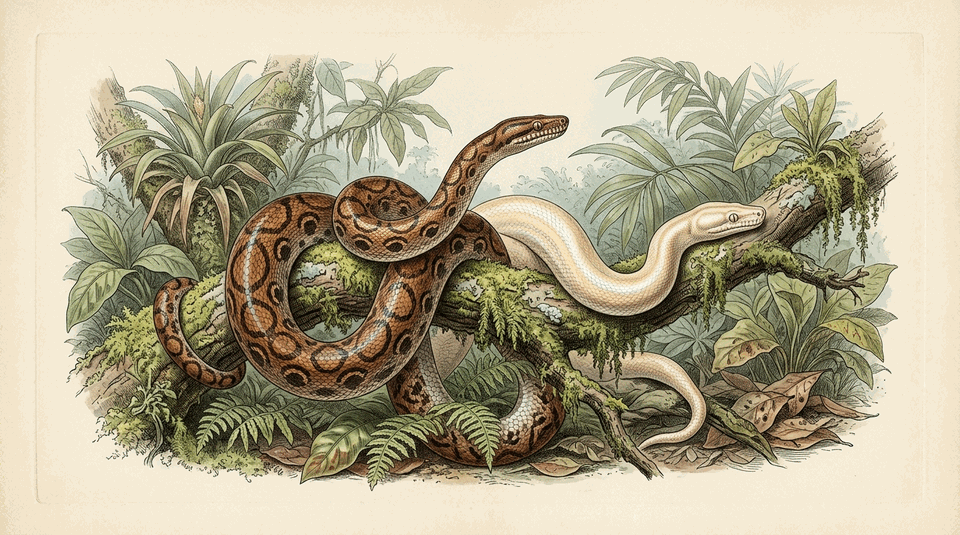
Red Tail Boa
Boa imperator (BCI) / Boa constrictor (BCC)
1. Habitat Layout & Temperature Gradient
Species: Boa imperator | Difficulty: 2/5 (Due to massive adult size) | Hardiness: 4/5

Critter Cabana & Gresham Pet Supply — Keeping Your Pet Healthy & Thriving
At a Glance

| Common Name | Red Tail Boa, Common Boa, Central American Boa |
| Species | Boa imperator (BCI) or Boa constrictor constrictor (BCC) |
| Origin | Central and South America |
| Adult Size | 6 to 10 feet (Females are significantly larger and heavier than males) |
| Lifespan | 20 to 30+ years |
| Diet Type | Carnivore (Rodents) |
| Activity | Primarily nocturnal / crepuscular |
| Temperament | Generally docile and slow-moving, but incredibly powerful. |
| Handleability | Great for experienced handlers. Due to their heavy bodies and sheer strength, large adults should be handled with caution. |
| Difficulty | 2/5 — Easy (Their husbandry is very simple, but their massive adult size requires commitment and space). |
| Hardiness | 4/5 — Hardy (Very resilient, excellent eaters). |
Taxonomy Note: In the pet trade, almost all "Red Tail Boas" are actually Boa imperator (BCI - Common Boas), which are slightly smaller, hardier, and have darker tails. The True Red Tail (Boa constrictor constrictor - BCC) has a vibrant red tail and grows much larger, but is rarer and more sensitive. This care sheet applies to the standard BCI common in the hobby.
Housing & Enclosure
Enclosure Type & Size
- Type: Terrestrial / Semi-Arboreal. While heavy-bodied adults stay on the ground, juveniles are highly arboreal and love to climb.
- Minimum for Babies: A 20-gallon long or a 24x18x18 front-opening terrarium.
- Minimum for Adults: A custom 6ft x 2ft x 2ft PVC enclosure is the absolute minimum for an adult female. PVC is highly recommended over glass because glass cannot hold the humidity and heat required for such a massive space.
Substrate
- Recommended: Cypress mulch (Forest Floor), coconut husk (ReptiBark or Coco Chips), or a bioactive soil mix. These hold humidity beautifully without molding.
- Avoid: Aspen shavings (will mold instantly when misted) and pine/cedar (toxic).
Décor & Enrichment
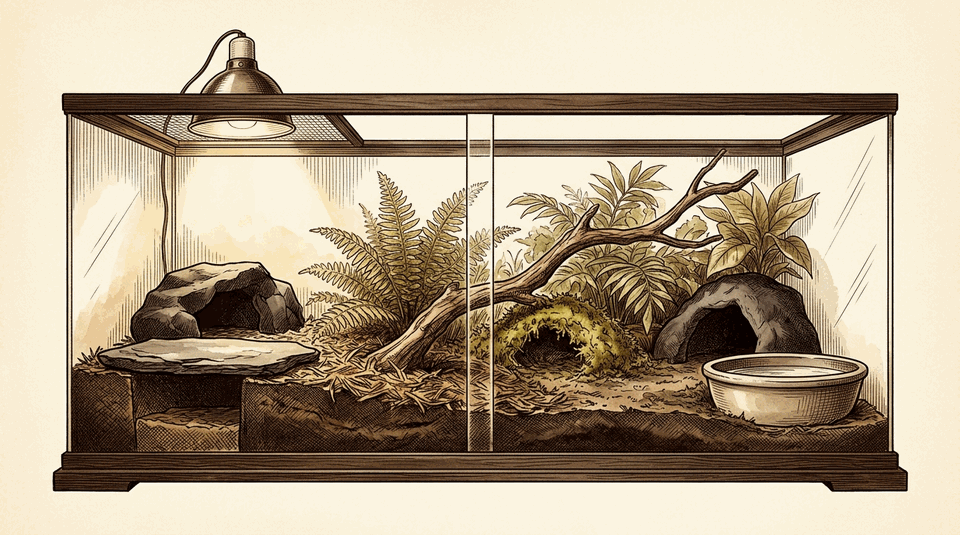
- Hides: Provide at least two large hides—one on the warm end, one on the cool end. Ensure they are snug; snakes like to feel the walls touching their sides.
- Climbing: Provide thick, sturdy branches securely anchored to the walls for juveniles to climb.
- Water Bowl: Provide a water bowl large enough for the snake to fully submerge and soak its entire body.
Heating & Lighting

Temperature Requirements
| Zone | Temperature |
|---|---|
| Basking Spot | 88–90°F (31–32°C) |
| Warm Ambient | 85°F (29°C) |
| Cool End | 80°F (26°C) |
| Nighttime Drop | 75–78°F (24–25°C) |
- Heating: Deep Heat Projectors (DHPs) or Radiant Heat Panels (RHPs) are the best options for large enclosures. Avoid under-tank heat mats for heavy-bodied adult boas, as they can cause severe thermal burns ("belly burns") if the snake sits on them for too long.
- Thermostat (CRITICAL): Every heat source must be plugged into a reptile thermostat to prevent fatal overheating.
Lighting & UVB
- UVB: Not strictly required for their survival, but providing a low-output UVB (like an Arcadia ShadeDweller or 5% Forest bulb) has proven beneficial for their immune system and circadian rhythm.
Humidity & Water
- Target Range: 50% to 70%.
- Shedding: Bump the humidity to 75-80% when you notice the snake's eyes turning cloudy (in "blue").
- How to Maintain: Mist the enclosure lightly with a pressure sprayer, or pour water directly into the corners of the substrate. If you are using a glass tank with a screen lid, cover 75% of the screen with HVAC foil tape to trap the moisture.
Diet & Nutrition

Boas are incredibly aggressive eaters with a slow metabolism. Overfeeding is the #1 cause of premature death in captive boas. A healthy boa should be shaped like a loaf of bread (with flat sides), not a round sausage.
Prey Size
- Prey should leave a slight, barely noticeable lump in the snake's belly. It should not be significantly wider than the thickest part of the snake's body.
Feeding Schedule
| Life Stage | Frequency | Prey Type |
|---|---|---|
| Babies (Under 1 year) | Every 7 to 10 days | Hopper Mice to Weaned Rats |
| Juveniles (1-3 years) | Every 14 to 21 days | Small to Medium Rats |
| Adults (3+ years) | Every 3 to 6 weeks | Large to Jumbo Rats |
Feeding Rules
- Avoid: Never feed live rodents to an adult boa. A live rat will fight back, bite the snake, and can cause horrific, fatal injuries. Always feed frozen/thawed prey.
- Avoid: Do not handle for 48 hours after feeding, or the snake will regurgitate its meal. Regurgitation destroys their esophageal flora and can be fatal.
Handling & Temperament
- Temperament: Most captive-bred boas are incredibly docile, slow-moving, and inquisitive. However, their feeding response is legendary.
- Tap Training: To avoid being bitten when you open the enclosure, use a snake hook to gently tap the boa on the nose before picking it up. This breaks their "feeding mode" and tells them it's time to be handled, not fed.
- The Two-Person Rule: Because an adult female boa can easily reach 8-10 feet and weigh over 30 pounds, you should always have a second person in the room when handling an adult. They are constrictors; if they wrap around your neck for balance and you panic, it can be dangerous.
What We Stock & Use in Our Stores
These are products we carry and recommend for this species. Ask any associate for help finding them in-store.
| Category | Product | Notes |
|---|---|---|
| Substrate | Zoo Med Forest Floor (Cypress Mulch) | Excellent for humidity retention |
| Heating | Arcadia Deep Heat Projector (DHP) | Penetrating infrared heat for deep tissue digestion |
| Safety | Zoo Med ReptiTemp Thermostat | 100% mandatory for all heat sources |
| Tools | 18-inch Feeding Tongs | Keep your hands far away during feeding time! |
Care sheet compiled by Critter Cabana & Gresham Pet Supply. For questions, ask any livestock specialist in-store.
Last updated: 2026-08-04
How We Keep Them at Critter Cabana & Gresham Pet Supply
- Beating Dry Oregon Furnace Air (and Summer Heat Spikes): Across the Willamette Valley and Portland Metro, running the house furnace all winter drops indoor humidity to 25–35%, which quickly causes stuck sheds and dehydration in screen-top tanks. To hold
50-70%reliably for Red Tail Boa, our crew uses a deep 3–5" substrate bed (or our store-shelf 10-Part Bioactive Mix of ReptiSoil, Coco Fiber, Orchiata Bark, Sphagnum Moss, and Leaf Litter), a dedicated humid hide packed with damp sphagnum moss, and partial screen cover when needed. - Thermostat & Linear UVB Standard: Every heating element in our Newberg and Gresham reptile rooms runs on a thermostat probe set to
Basking 88-90°F / Cool 80-85°Fon the warm side with acomfortable room temperaturecool retreat, paired withfalseon a 12-hour day/night timer. In summer, if an upstairs room climbs above 82°F, a dimming thermostat automatically backs down the basking lamp so the cool side never overheats. - Stocked at Newberg & Gresham: We stock reptile enclosures, thermostats, Arcadia & Zoo Med UVB lighting, bioactive substrate ingredients, live Springtails, Dwarf White, Powder Blue/Orange, Dairy Cow, and Giant Canyon isopods, and gut-loaded crickets, dubia roaches, hornworms, and frozen-thawed rodents at Critter Cabana (Newberg) and Gresham Pet Supply.
Common Questions (FAQ)
What size tank does an adult Red Tail Boa actually need?
An adult Red Tail Boa needs at least 40-Gal Breeder (Juvenile) -> Custom Large Adult Enclosure so you can maintain a true thermal gradient from Basking 88-90°F / Cool 80-85°F on the warm/basking side down to comfortable room temperature on the cool side.
How do I keep Red Tail Boa humidity at 50-70% during dry Oregon winters?
Oregon winter furnace heat dries out thin bedding fast. Use a 3–5 inch moisture-retaining substrate mix (such as Zoo Med ReptiSoil blended with coco fiber, Orchiata bark, and sphagnum moss), provide an enclosed humid hide, and cover 50–70% of an open screen top with HVAC foil tape or a PVC panel if ambient humidity drops too low.
What is the best bioactive clean-up crew for a Red Tail Boa?
Pair Temperate White Springtails with a humidity-matched isopod species (such as Powder Blue/Orange for semi-arid setups or Dwarf White / Dairy Cow isopods for humid forest setups) in a 3–5 inch bioactive soil and leaf-litter bed. You can pick up our 1-Page or Tri-Fold Bioactive Substrate Recipe Guide and live cultures at Critter Cabana (Newberg) or Gresham Pet Supply.
Where can I get Red Tail Boa setup supplies, live feeders, and thermostats in Oregon?
We stock our full reptile, amphibian, and bioactive setup supplies—including enclosures, thermostats, Arcadia and Zoo Med UVB lighting, bioactive substrates, live isopods/springtails, and live or frozen feeders—at Critter Cabana in Newberg (514 E First St, 503-537-2887) and Gresham Pet Supply (2185 NW Burnside Rd, 503-665-7606).