
Red-Eared Slider
Trachemys scripta elegans
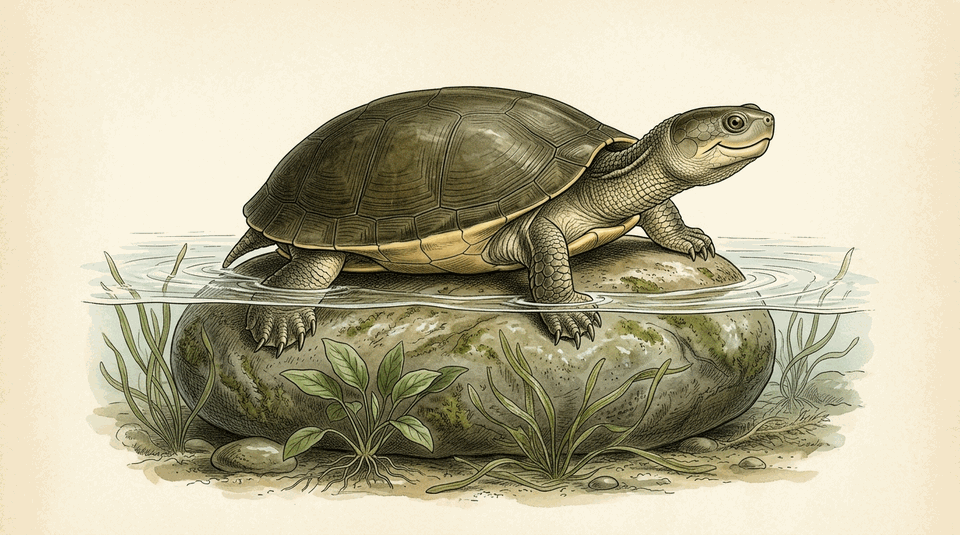
1. Warm Swimming Water + Bone-Dry Basking Dock

2. Two Great Ways to Set Up Your Habitat
Tank Style: Wide Breeder / Low-Boy Tank vs. Oval Tub
Side-Neck Turtles are active bottom-walkers and swimmers that care way more about floor space than deep water:
Option A: 40-Gal Breeder or 50-Gal Low-Boy Glass Tank (Our Top Pick!)
Great for watching them swim up to greet you! Pair with a floating basking dock or stacked flat river stone island.
Option B: Heavy-Duty 40+ Gal Oval Stock Tank Lagoon
Molded oval tubs make awesome, indestructible turtle lagoons with tons of floor space and easy overhead lamp clamping.
Bottom Flooring: Bare Glass vs. Fine River Sand
Big No-No: never use small colorful fish gravel—turtles eat pebbles and get fatal gut blockages!
Option A: Bare Bottom + Smooth River Boulders
Super easy to vacuum clean during weekly water changes, with big stones (larger than their head) for gripping.
Option B: Fine Aquarium / River Sand
Side-Necks love burying themselves in fine sand on the bottom, and fine sand passes safely if they swallow a few grains.
Keeping the Water Clean
Real talk: one turtle makes about 3× as much waste as a fish of the same size!
Option A: Canister Filter Rated 2–3× Your Tank Gallon Size
On a 75-gallon tank, run a filter rated for 150–200 gallons and do a quick 25–30% water change once a week.
Option B: Feed Messy Meals in a Separate Tub
Feeding worms, krill, and pellets in a separate plastic tub of warm dechlorinated water keeps your main tank crystal clear way longer!

3. What to Feed (Remember: They Can Only Swallow Underwater!)
Favorite Turtle Foods We Carry:
Balanced growth & maintenance formulas
Nightcrawlers, Dubia roaches, frozen turtle cubes
Dandelion, red leaf lettuce, duckweed, hornwort
Keeps shells hard and prevents peeling scutes

4. Four Keys to a Happy, Thriving Red-Eared Slider
100% Dry Basking Dock
Your turtle needs to be able to climb completely out of the water under both heat (90–95°F) and UVB so both the top AND bottom of its shell get bone-dry—that's what prevents shell rot!
Shatterproof Heater
Turtles love bulldozing tank decor! Always use a plastic-guarded or titanium submersible water heater so they can't crack a glass heater tube.
Watch Those Back Claws!
Hold your turtle like a hamburger with both hands supporting its belly—they have surprisingly strong back legs and will kick like crazy if they feel like they're falling.
Wash Hands & Skip Kitchen Sink
Always wash your hands with soap after touching turtle water, and dump dirty tank buckets in the bathroom or yard rather than where you wash dishes!

Bring-Home Shopping Checklist
Tap items to check them off on your phone while you shop at Critter Cabana.
Tank, Basking Dock & Sand
Heater, Big Filter & UVB
Pellets, Protein & Calcium
Complete Reference Notes & Oregon Keeping Guide
Species: Trachemys scripta elegans | Difficulty: 2/5 — Easy | Hardiness: 5/5 — Bulletproof
Critter Cabana & Gresham Pet Supply — Keeping Your Pet Healthy & Thriving
At a Glance
| Common Name | Red-Eared Slider (RES) |
| Species | Trachemys scripta elegans |
| Origin | Ponds and slow-moving rivers of the Southern USA |
| Adult Size | Males: 7 to 9 inches. Females: 10 to 12 inches. |
| Lifespan | 20 to 30+ years |
| Diet Type | Omnivore (Aquatic turtle pellets, greens, fish, insects) |
| Activity | Diurnal (Active during the day, spends hours basking) |
| Temperament | Highly active and incredibly food-motivated. They will beg at the glass when you walk into the room. |
| Handleability | Poor. They have sharp claws, a surprisingly long neck, and a strong bite. They are aquatic animals and get highly stressed when removed from water. |
| Difficulty | 2/5 — Easy (But requires a massive amount of space and heavy-duty filtration) |
| Hardiness | 5/5 — Bulletproof |
Why We Love Them: Red-Eared Sliders are the most iconic pet turtle in the world. They are incredibly hardy, interactive, and fun to watch swim. However, they are frequently sold as tiny, quarter-sized babies to people who do not realize they will quickly grow to the size of a dinner plate and require a massive aquarium.
The Salmonella Warning

WASH YOUR HANDS: All aquatic turtles naturally carry Salmonella bacteria in their intestinal tract, which ends up in their tank water. You must wash your hands thoroughly with hot soap and water every single time you handle the turtle, touch the water, or clean the filter. Never let young children handle the turtle unsupervised, and never wash turtle equipment in the kitchen sink.
Housing & Aquarium
Tank Size (The 10-Gallon Rule)
- The Rule: You need 10 gallons of water for every 1 inch of turtle shell length. An 8-inch adult needs an 80-gallon tank.
- Minimum Size (Babies): A 20-gallon "Long" aquarium. They will outgrow this within a year.
- Minimum Size (Adults): A 75 to 100-gallon aquarium, or a large indoor/outdoor pond.
- Water Depth: The water must be at least twice as deep as the turtle is long, so if they flip over, they have enough room to right themselves and not drown.
Filtration (CRITICAL)
- Turtles Are Messy: Turtles produce an incredible amount of solid waste. Standard hang-on-back fish filters will clog instantly.
- Canister Filters: You must use a heavy-duty Canister Filter (like a Fluval FX4 or Zoo Med Turtle Clean) rated for 2 to 3 times the actual water volume in the tank. If you have 50 gallons of water, you need a filter rated for 150 gallons.
The Basking Dock
- Turtles are cold-blooded and must climb completely out of the water to dry off and warm up.
- You must provide a sturdy, floating turtle dock (or a custom-built above-tank basking platform) that is completely dry and large enough for the turtle to stretch its legs out fully.
Heating & Lighting

Temperature Requirements
| Zone | Temperature |
|---|---|
| Basking Dock Surface | 90–95°F (32–35°C) |
| Water Temperature | 74–78°F (23–26°C) |
- Water Heater: Use a submersible aquarium heater. It is highly recommended to use a heater with a plastic guard, as large turtles will smash unprotected glass heaters against the tank walls.
- Basking Heat: Position a halogen heat lamp directly over the dry basking dock.
Lighting & UVB (CRITICAL)
- UVB: A turtle's shell is made of bone. Without intense UVB light, their shell will become soft and deformed (Metabolic Bone Disease), which is fatal. You must mount a T5 HO UVB bulb (or a mercury vapor bulb) directly over the basking dock. UVB does not penetrate glass or water.
Diet & Nutrition
Sliders are omnivores. Hatchlings are almost entirely carnivorous, but as they age, they shift to a mostly herbivorous diet.
Feeding Location
- In the Water: Sliders cannot produce saliva and must swallow their food underwater.
- Pro Tip: To keep the main tank clean, place the turtle in a separate, small plastic tub filled with tank water at feeding time.
The Diet
- Staples: High-quality aquatic turtle pellets (Zoo Med, Mazuri, Omega One).
- Vegetables (For Adults): Daily offerings of dark leafy greens (dandelion greens, red leaf lettuce, collard greens). Avoid iceberg lettuce.
- Protein (Treats): Freeze-dried shrimp, earthworms, or live feeder fish (minnows or guppies). Never feed goldfish or rosy red minnows, as they contain an enzyme (thiaminase) that destroys the turtle's vitamin B1.
What We Stock & Use in Our Stores
These are products we carry and recommend for this species. Ask any associate for help finding them in-store.
| Category | Product | Notes |
|---|---|---|
| Water Care | Seachem Prime | Essential for removing toxic chlorine from tap water |
| Lighting | Zoo Med Aquatic Turtle Lighting Combo | Provides both heat and essential UVB over the dock |
| Diet | Zoo Med Aquatic Turtle Pellets | Specifically formulated for different life stages (Hatchling, Growth, Maintenance) |
| Enrichment | Zoo Med Floating Turtle Dock | The easiest way to provide a dry basking spot |
Care sheet compiled by Critter Cabana & Gresham Pet Supply. For questions, ask any livestock specialist in-store.
Last updated: 2026-08-04
How We Keep Them at Critter Cabana & Gresham Pet Supply
- Beating Dry Oregon Furnace Air (and Summer Heat Spikes): Across the Willamette Valley and Portland Metro, running the house furnace all winter drops indoor humidity to 25–35%, which quickly causes stuck sheds and dehydration in screen-top tanks. To hold
Aquaticreliably for Red-Eared Slider, our crew uses a deep 3–5" substrate bed (or our store-shelf 10-Part Bioactive Mix of ReptiSoil, Coco Fiber, Orchiata Bark, Sphagnum Moss, and Leaf Litter), a dedicated humid hide packed with damp sphagnum moss, and partial screen cover when needed. - Thermostat & Linear UVB Standard: Every heating element in our Newberg and Gresham reptile rooms runs on a thermostat probe set to
Basking 90-95°F / Water 75°Fon the warm side with acomfortable room temperaturecool retreat, paired withtrueon a 12-hour day/night timer. In summer, if an upstairs room climbs above 82°F, a dimming thermostat automatically backs down the basking lamp so the cool side never overheats. - Stocked at Newberg & Gresham: We stock reptile enclosures, thermostats, Arcadia & Zoo Med UVB lighting, bioactive substrate ingredients, live Springtails, Dwarf White, Powder Blue/Orange, Dairy Cow, and Giant Canyon isopods, and gut-loaded crickets, dubia roaches, hornworms, and frozen-thawed rodents at Critter Cabana (Newberg) and Gresham Pet Supply.
Common Questions (FAQ)
What size tank does an adult Red-Eared Slider actually need?
An adult Red-Eared Slider needs at least 75 to 100-Gallon Aquarium (Adults) so you can maintain a true thermal gradient from Basking 90-95°F / Water 75°F on the warm/basking side down to comfortable room temperature on the cool side.
How do I keep Red-Eared Slider humidity at Aquatic during dry Oregon winters?
Oregon winter furnace heat dries out thin bedding fast. Use a 3–5 inch moisture-retaining substrate mix (such as Zoo Med ReptiSoil blended with coco fiber, Orchiata bark, and sphagnum moss), provide an enclosed humid hide, and cover 50–70% of an open screen top with HVAC foil tape or a PVC panel if ambient humidity drops too low.
What is the best bioactive clean-up crew for a Red-Eared Slider?
Pair Temperate White Springtails with a humidity-matched isopod species (such as Powder Blue/Orange for semi-arid setups or Dwarf White / Dairy Cow isopods for humid forest setups) in a 3–5 inch bioactive soil and leaf-litter bed. You can pick up our 1-Page or Tri-Fold Bioactive Substrate Recipe Guide and live cultures at Critter Cabana (Newberg) or Gresham Pet Supply.
Where can I get Red-Eared Slider setup supplies, live feeders, and thermostats in Oregon?
We stock our full reptile, amphibian, and bioactive setup supplies—including enclosures, thermostats, Arcadia and Zoo Med UVB lighting, bioactive substrates, live isopods/springtails, and live or frozen feeders—at Critter Cabana in Newberg (514 E First St, 503-537-2887) and Gresham Pet Supply (2185 NW Burnside Rd, 503-665-7606).