
Milk Snake
Lampropeltis triangulum (Multiple Subspecies)
1. Escape-Proof Tank & Warm-to-Cool Setup

2. Two Great Ways to Set Up Your Habitat
Heating: Belly Heat Mat vs. Overhead Bulb
Milksnakes are secretive burrowers that digest fast when given a steady 85–88°F warm zone:
Option A: Under-Tank Heat Mat + Digital Thermostat (Our Top Pick)
Because Milksnakes spend most of the day tucked under flat caves, belly heat on a thermostat set to 86°F works like a charm.
Option B: 50W–75W Basking Bulb or Deep Heat Projector
Warms a flat rock and the air above it—great for 20-gallon and 40-gallon glass tanks.
Bedding: Shredded Aspen vs. Reptile Soil/Cypress
Give your Milksnake 3–4 inches of loose bedding to tunnel through:
Option A: Shredded Aspen Snake Bedding
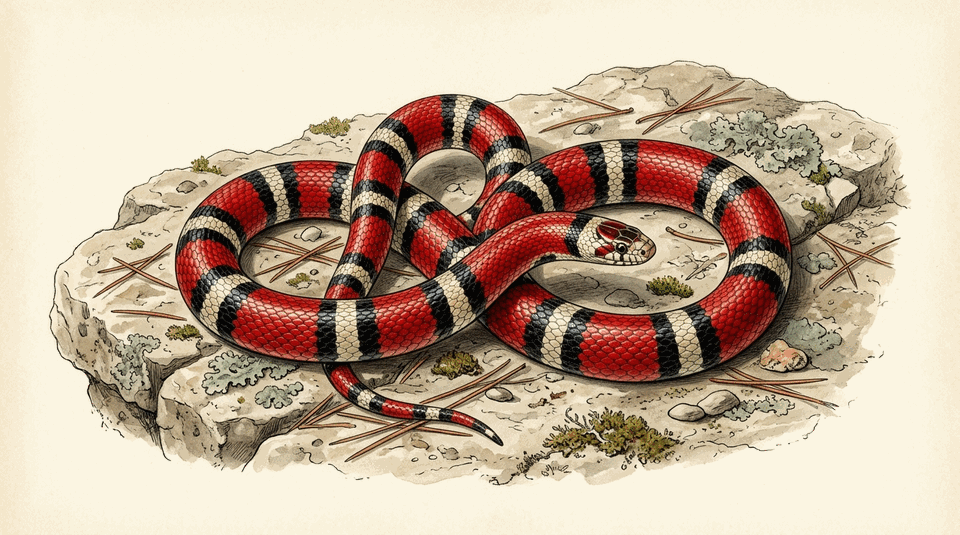
Stays dry, holds tunnels well, and makes their bright red-black-white bands pop!
Option B: Reptile Soil or Cypress Mulch Mix
Awesome for naturalistic tanks and holding steady humidity in winter—pair with Powder Orange/Blue or Dalmatian (P. scaber) Isopods + Springtails for bioactive cleanup!
Lighting: Shade UVB vs. Simple LED
Since whole mice already supply 100% of their calcium and Vitamin D3, either lighting option works:
Option A: Low-Output Shade UVB (5%–7%)
Makes their crimson and cream rings glow and encourages dusk exploring.
Option B: Simple Day/Night Room or LED Light
Works great as long as they get a clear day/night cycle and pitch darkness at night.

3. Feeding Guide (Frozen/Thawed Mice)
Big Rules for Milksnake Keepers:
Kingsnakes & Milksnakes eat other snakes—100% solo!
Milksnakes love food and will eagerly charge dinner
Don't handle your snake right after touching mice
Leave them alone for 2 full days after every meal

4. Four Keys to a Happy, Thriving Milk Snake
Strictly One Per Tank!
All Kingsnakes and Milksnakes (Lampropeltis) are natural snake-eaters in the wild. Never put two snakes in the same tank or hold two snakes at the same time!
Clip That Screen Lid
They have strong, wedge-shaped noses built for prying under rocks—always use metal screen clips or locking front doors.
Blue Eyes = Shed Week
When their eyes turn cloudy blue, skip handling and mist their moss cave daily until the old skin rolls off in one clean piece.
Flat Cork Bark Trick
Lay 1 or 2 flat slabs of natural cork bark right on top of the bedding—Milksnakes love wedging themselves flat under bark even more than dome caves!

Bring-Home Shopping Checklist
Tap items to check them off on your phone while you shop at Critter Cabana.
Locking Tank & Bedding
Heating & Thermostat
Caves, Bowl & Mice
Complete Reference Notes & Oregon Keeping Guide
Species: Lampropeltis triangulum | Difficulty: 2/5 — Easy | Hardiness: 4/5 — Hardy
Critter Cabana & Gresham Pet Supply — Keeping Your Pet Healthy & Thriving
At a Glance
| Common Name | Milk Snake (Pueblan, Honduran, Nelson's, Sinaloan) |
| Species | Lampropeltis triangulum |
| Origin | Spans from Canada to Ecuador |
| Adult Size | Varies by subspecies. Pueblans stay small (2.5-3 ft). Hondurans get massive (5-6 ft). |
| Lifespan | 15 to 20 years |
| Diet Type | Carnivore (Rodents) |
| Activity | Primarily nocturnal / crepuscular |
| Temperament | Flighty and nervous as babies (they will rattle their tail and musk). Very calm and docile as adults. |
| Handleability | Great for beginners. They are very active and love to explore while being handled. |
| Difficulty | 2/5 — Easy (Bulletproof beginner snakes) |
| Hardiness | 4/5 — Hardy (Excellent eaters, rarely go on hunger strikes) |
Why We Love Them: Milk snakes are famous for their brilliant red, black, and yellow banding, which evolved to mimic the highly venomous Coral Snake (remember the rhyme: "Red touches yellow, kills a fellow. Red touches black, friend of Jack"). They are closely related to Kingsnakes and share their legendary appetite and hardiness, making them one of the best beginner reptiles in the hobby.
The Cannibalism Warning

STRICTLY SOLITARY: Milk snakes belong to the genus Lampropeltis (which includes Kingsnakes). They are naturally ophiophagous—meaning they eat other snakes in the wild. If you put two milk snakes in the same enclosure, one will eventually eat the other. Never cohabitate them.
Housing & Enclosure
Enclosure Type & Size
- Type: Terrestrial / Burrowing. Floor space is more important than height.
- Minimum for Babies: A 10-gallon tank or a small plastic tub.
- Minimum for Adults: A 40-gallon breeder (36" x 18" x 18") is standard for smaller subspecies (Pueblan, Sinaloan). Large subspecies (like the Honduran Milk Snake) require a 4ft x 2ft x 2ft enclosure.
- Security (CRITICAL): Milk snakes are notoriously talented escape artists. Their narrow heads allow them to push through incredibly tiny gaps. Ensure the lid has locking clips and there are no holes for wires that the snake could squeeze through.
Substrate
- Recommended: Aspen shavings (Sani-Chips or shredded aspen) are excellent because they hold burrows perfectly. Alternatively, use a bioactive dirt mix or coconut fiber if your home is very dry.
- Depth: Provide at least 2 to 3 inches of substrate. They love to tunnel.
Décor & Enrichment
- Hides: Provide at least two tight-fitting hides (one on the warm end, one on the cool).
- Climbing: While terrestrial, they are active explorers and will utilize low branches and cork bark tubes.
Heating & Lighting

Temperature Requirements
| Zone | Temperature |
|---|---|
| Basking Spot | 85–88°F (29–31°C) |
| Warm Ambient | 80–84°F (26–28°C) |
| Cool End | 70–75°F (21–24°C) |
| Nighttime Drop | 65–70°F (18–21°C) |
- Heating: An under-tank heat mat or a ceramic heat emitter (CHE) are perfect.
- Thermostat (Mandatory): All heat sources must be plugged into a thermostat. Unregulated heat mats can easily reach 120°F+ and will cause fatal burns to a burrowing snake.
Lighting & UVB
- UVB: Not strictly required for their survival, as they are nocturnal and get their Vitamin D3 entirely from the livers of the mice they eat. However, a low-output UVB bulb (like the Arcadia ShadeDweller) is beneficial for their immune system.
Humidity & Water
- Target Range: 40% to 60% (Standard household humidity).
- The Humid Hide: To ensure perfect, one-piece sheds, provide a "humid hide" (a plastic container with a hole cut in the lid, filled with damp sphagnum moss).
- Water Bowl: Provide a water bowl large enough for the snake to soak its entire body.
Diet & Nutrition
Prey Size
- Feed mice that are slightly wider than the thickest part of the snake's body. The snake should have a small, barely noticeable lump after eating.
Feeding Schedule
| Life Stage | Frequency | Prey Type |
|---|---|---|
| Babies | Every 5 to 7 days | Pinky to Fuzzy Mice |
| Juveniles | Every 7 to 10 days | Hopper to Adult Mice |
| Adults | Every 10 to 14 days | Adult to Jumbo Mice |
Feeding Rules
- Avoid: Frozen/Thawed Only: Never feed live rodents. A live mouse can bite and severely injure your snake.
- Avoid: No Handling: Do not handle the snake for 48 hours after feeding to prevent regurgitation.
What We Stock & Use in Our Stores
These are products we carry and recommend for this species. Ask any associate for help finding them in-store.
| Category | Product | Notes |
|---|---|---|
| Heating | Zoo Med ReptiTherm Under Tank Heater | Excellent for burrowing snakes (must use a thermostat) |
| Safety | Zoo Med ReptiTemp Thermostat | 100% mandatory for all heat sources |
| Substrate | Zoo Med Aspen Snake Bedding | Holds burrows perfectly |
| Enrichment | Zoo Med Sphagnum Moss | Use inside a humid hide for perfect sheds |
Care sheet compiled by Critter Cabana & Gresham Pet Supply. For questions, ask any livestock specialist in-store.
Last updated: 2026-08-04
How We Keep Them at Critter Cabana & Gresham Pet Supply
- Beating Dry Oregon Furnace Air (and Summer Heat Spikes): Across the Willamette Valley and Portland Metro, running the house furnace all winter drops indoor humidity to 25–35%, which quickly causes stuck sheds and dehydration in screen-top tanks. To hold
40-60% (With a humid hide)reliably for Milk Snake, our crew uses a deep 3–5" substrate bed (or our store-shelf 10-Part Bioactive Mix of ReptiSoil, Coco Fiber, Orchiata Bark, Sphagnum Moss, and Leaf Litter), a dedicated humid hide packed with damp sphagnum moss, and partial screen cover when needed. - Thermostat & Linear UVB Standard: Every heating element in our Newberg and Gresham reptile rooms runs on a thermostat probe set to
Basking 85-88°F / Cool 75°Fon the warm side with acomfortable room temperaturecool retreat, paired withfalseon a 12-hour day/night timer. In summer, if an upstairs room climbs above 82°F, a dimming thermostat automatically backs down the basking lamp so the cool side never overheats. - Stocked at Newberg & Gresham: We stock reptile enclosures, thermostats, Arcadia & Zoo Med UVB lighting, bioactive substrate ingredients, live Springtails, Dwarf White, Powder Blue/Orange, Dairy Cow, and Giant Canyon isopods, and gut-loaded crickets, dubia roaches, hornworms, and frozen-thawed rodents at Critter Cabana (Newberg) and Gresham Pet Supply.
Common Questions (FAQ)
What size tank does an adult Milk Snake actually need?
An adult Milk Snake needs at least 40-Gallon Breeder (36x18x18) so you can maintain a true thermal gradient from Basking 85-88°F / Cool 75°F on the warm/basking side down to comfortable room temperature on the cool side.
How do I keep Milk Snake humidity at 40-60% (With a humid hide) during dry Oregon winters?
Oregon winter furnace heat dries out thin bedding fast. Use a 3–5 inch moisture-retaining substrate mix (such as Zoo Med ReptiSoil blended with coco fiber, Orchiata bark, and sphagnum moss), provide an enclosed humid hide, and cover 50–70% of an open screen top with HVAC foil tape or a PVC panel if ambient humidity drops too low.
What is the best bioactive clean-up crew for a Milk Snake?
Pair Temperate White Springtails with a humidity-matched isopod species (such as Powder Blue/Orange for semi-arid setups or Dwarf White / Dairy Cow isopods for humid forest setups) in a 3–5 inch bioactive soil and leaf-litter bed. You can pick up our 1-Page or Tri-Fold Bioactive Substrate Recipe Guide and live cultures at Critter Cabana (Newberg) or Gresham Pet Supply.
Where can I get Milk Snake setup supplies, live feeders, and thermostats in Oregon?
We stock our full reptile, amphibian, and bioactive setup supplies—including enclosures, thermostats, Arcadia and Zoo Med UVB lighting, bioactive substrates, live isopods/springtails, and live or frozen feeders—at Critter Cabana in Newberg (514 E First St, 503-537-2887) and Gresham Pet Supply (2185 NW Burnside Rd, 503-665-7606).