
Jumping Spider
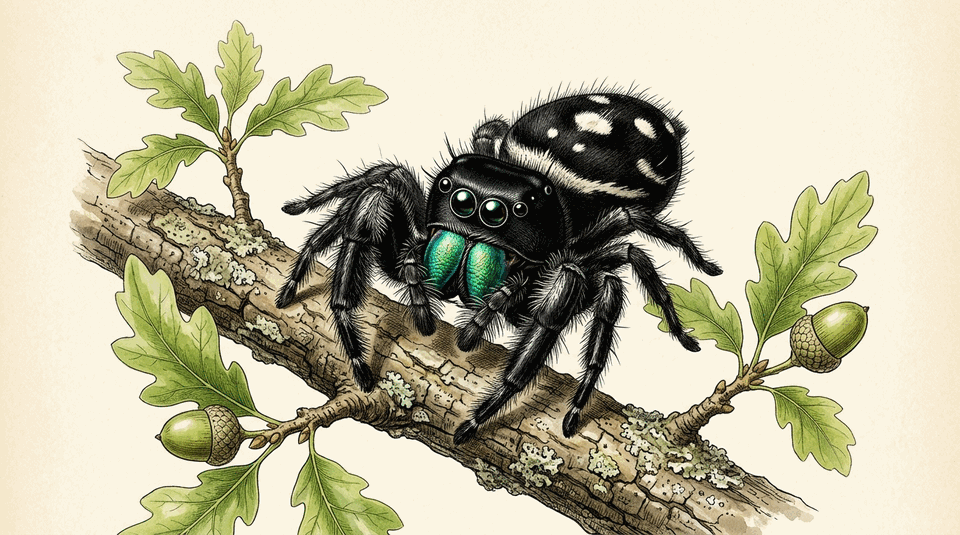
Phidippus spp.
1. Cross-Ventilated Cube & Protecting the Top Web!

2. Two Great Ways to Set Up Your Habitat
Enclosure: Protect Their Ceiling Hammock!
Jumping spiders ALWAYS spin their silk sleeping and molting hammock in the very top ceiling corner:
Option A: Zilla Arboreal Micro Habitat or Front-Opening Nano Cube (Our Top Pick)
Front-opening doors let you mist and drop bugs in without ever tearing their ceiling web!
Option B: Bottom-Opening Arboreal Cube
Or flip a clear acrylic cube upside-down so the base is on the table, keeping their upstairs bedroom 100% intact.
How to Give Water (No Open Water Bowls!)
A jumping spider can drown in an open dish or even a giant water puddle:
Option A: Ultra-Fine Mist Droplets on One Wall Every Morning
Use a fine-mist spray bottle to spritz tiny poppy-seed-sized water beads on one clear wall (never spray straight into their silk hammock!).
Option B: Damp Q-Tip or Moist Sphagnum Moss Ball at the Bottom
Gives them a safe place to sip moisture with zero drowning risk.
Give Them a Bright Daytime Light!
Unlike tarantulas that love the dark, Jumping Spiders are visual daytime hunters—if the tank is dim, they'll just sit in bed all day:
Option A: Overhead LED Desk or Plant Lamp (12 Hrs/Day)
A bright, cool-running LED light right over the cube wakes them up and gets them exploring and hunting!
Option B: Bright Room Desk (NEVER in Direct Window Sun!)
Big Warning: never set an acrylic cube in a sunny window—it turns into a greenhouse oven and hits 105°F in 5 minutes!

3. Feeding by 'Booty Size' (Not a Calendar!)
Favorite Jumper Snacks We Carry:
Best staple for babies & juveniles
Triggers awesome cat-like stalking pounces!
Put in a magnetic wall cup so they can't burrow
A loose cricket can bite a sleeping or molting spider!

4. Four Keys to a Happy, Thriving Jumping Spider
Decorate the Top 2 Inches!
Jumpers spend 90% of their life right under the ceiling! Stick magnetic ledges, walnut hides, and fake flowers up in the top 2 inches of the cube.
Leave Molting Spiders Alone
Never poke or try to coax a spider out of a thick white hammock! Just keep spritzing water droplets on the opposite wall daily until they pop out in their fresh coat.
Zero Perfumes or Candles!
Scented candles, room sprays, bug spray, and dog flea drops on your hands can be fatal to jumping spiders—always wash hands with plain soap first!
Invisible Safety Bungee
Before jumping onto your hand, they glue a tiny invisible silk safety line to your finger! Move slowly so you don't spook them.

Bring-Home Shopping Checklist
Tap items to check them off on your phone while you shop at Critter Cabana.
Front-Opening Cube & Upstairs Decor
Bright LED Light & Fine Mister
Live Feeder Bugs
Complete Reference Notes & Oregon Keeping Guide
Species: Phidippus spp. (e.g., Regal Jumping Spider, Bold Jumping Spider) | Difficulty: 2/5 — Easy | Hardiness: 3/5 — Moderate
Critter Cabana & Gresham Pet Supply — Keeping Your Pet Healthy & Thriving
At a Glance
| Common Name | Jumping Spider |
| Species | Phidippus regius, Phidippus audax, etc. |
| Origin | Widespread across North America and the Caribbean |
| Adult Size | 0.5 to 1 inch |
| Lifespan | 1 to 2 years (Males live slightly shorter lives than females) |
| Diet Type | Insectivore (Flies, small crickets, mealworms) |
| Activity | Diurnal (Highly active hunters during the daytime) |
| Temperament | Incredibly curious and intelligent. They will watch you, track your finger, and explore their environment actively. |
| Handleability | Excellent. They rarely bite and are known for being very inquisitive, often happily hopping onto an offered hand. |
| Difficulty | 2/5 — Easy (A fantastic, engaging starter spider) |
| Hardiness | 3/5 — Moderate (Require a very specific feeding and misting routine) |
Why We Love Them: Jumping spiders are the "puppy dogs" of the spider world. Unlike tarantulas, which often hide and rely on vibration, jumping spiders have incredible eyesight. They will look right at you, tilt their heads, and actively hunt their prey using calculated, precise jumps.
Housing & Enclosure
Terrarium Setup
- Type: Arboreal. They prefer to climb and build their web hammocks at the very top of their enclosure.
- Size: They are very small. A 4x4x8 inch or 5x5x9 inch acrylic enclosure (like those from Tarantula Cribs or Zilla Micro Habitats) is perfect.
- The "Front-Opening" Rule: Because jumping spiders build their hammock nests at the top corners of the enclosure, do not use a top-opening enclosure. If you open the top, you will rip their nest apart every time you feed them. Use a front-opening or bottom-opening enclosure.
Substrate & Decor
- Substrate: A thin layer of Coco Coir (Eco-Earth) or paper towel to hold a little humidity.
- Decor: Fill the top half of the enclosure with fake foliage, cork bark tubes, and twigs. They need anchor points near the ceiling to build their hammocks.
Environment & Husbandry
Temperature & Lighting
- Temperature: Standard room temperature (70-80°F) is perfect. They do not need external heat mats.
- Lighting: Jumping spiders are diurnal, visual hunters. They require a bright environment to hunt successfully. Provide a bright LED light near their enclosure during the day (but ensure it doesn't overheat the tiny enclosure).
Water & Humidity
- Misting: Do not put a water dish in the enclosure; they can easily drown. Instead, use a fine mist spray bottle to mist one side of the enclosure wall every 1-2 days. They will drink the water droplets off the acrylic.
- Aim for 50-70% humidity. Ensure the enclosure dries out between mistings to prevent mold.
Diet & Feeding
- Staple Diet: They prefer flying prey but will eat a variety of insects.
- Slings (Babies): Flightless fruit flies (D. melanogaster or D. hydei).
- Adults: Blue bottle flies, small crickets, or small mealworms.
- Feeding Schedule: Feed 1-2 items every 3 to 5 days. Watch their abdomen size; if it looks round and plump, they are full. If it looks shriveled or thin, feed them.
- Hunting: They stalk their prey like cats and pounce. Remove any uneaten prey (especially crickets) after a few hours so it doesn't bite the spider while it sleeps.
Molting
- When preparing to molt, the spider will build an extra-thick, white hammock and seal itself inside.
- Do not disturb the hammock or feed the spider while it is inside. Continue to lightly mist the outside wall so it stays hydrated, and wait for it to emerge on its own.
What We Stock & Use in Our Stores
| Category | Product | Notes |
|---|---|---|
| Housing | Zilla Micro Habitat (Arboreal) | Excellent front-opening design |
| Decor | Zoo Med Cork Bark Branches | Provides essential climbing structure |
| Hydration | Exo Terra Fine Mister Spray Bottle | Essential for providing drinking droplets |
| Diet | Flightless Fruit Flies / Small Crickets | The best active prey for hunters |
Care sheet compiled by Critter Cabana & Gresham Pet Supply.
Last updated: 2026-08-04
How We Keep Them at Critter Cabana & Gresham Pet Supply
- Oregon Winter Furnace Air vs. Molting Humidity: When Pacific Northwest furnaces kick on from October through April, indoor room humidity drops fast and dries out small enclosures from the top down. Rather than misting the spider or invert directly (which stresses terrestrial species and invites stagnant mold), we keep Jumping Spider at
50-70%by using a deep moisture-retaining substrate bed (ReptiSoil + Coco Fiber + Sphagnum Moss), overflowing the water dish slightly into one corner, and maintaining cross-ventilation. - Safe Room Heating in the Willamette Valley: If your house drops below 65°F on winter nights, never stick a heat pad on the bottom of a burrowing invertebrate tank—they dig down to escape heat and will cook themselves. Use a low-wattage side-mounted heat mat on a digital thermostat or warm the room ambiently to
70-80°F. - Stocked at Newberg & Gresham: At Critter Cabana (Newberg) and Gresham Pet Supply, we stock acrylic and glass invertebrate enclosures, cork bark flats and tubes, bioactive substrates, flightless fruit flies (D. melanogaster and D. hydei), pinhead to adult crickets, dubia roaches, and live Temperate White Springtail and Isopod cultures.
Common Questions (FAQ)
How do I keep my Jumping Spider warm and humid enough during an Oregon winter?
Target 70-80°F and 50-70%. When Oregon winter furnaces dry out the air, use a deep 3–5 inch substrate mix of Zoo Med ReptiSoil and coco fiber, keep a shallow water dish filled, and dampen one corner of the substrate rather than misting the animal directly. Never put a heat mat underneath a burrowing invertebrate enclosure.
What size enclosure does a Jumping Spider need?
An adult Jumping Spider thrives in Small Vertical Arboreal Enclosure with secure ventilation. For terrestrial tarantulas and scorpions, floor space and deep substrate matter most (keep open fall height low so heavy-bodied species cannot rupture their abdomen); for arboreal species, prioritize vertical cork bark tubes and cross-ventilation.
Can I put isopods in a Jumping Spider bioactive enclosure?
Around molting tarantulas and scorpions, skip protein-hungry large isopods and stick to Temperate White Springtails (or gentle Dwarf White isopods in humid detritivore setups) so a soft, newly molted animal is never nibbled.
Where can I find Jumping Spider, cork bark, and feeder insects in Oregon?
We stock live invertebrates, tarantulas, jumping spiders, cork bark flats and tubes, bioactive substrates, and gut-loaded feeder insects at our two exotic animal stores: Critter Cabana in Newberg (514 E First St, 503-537-2887) and Gresham Pet Supply (2185 NW Burnside Rd, 503-665-7606).