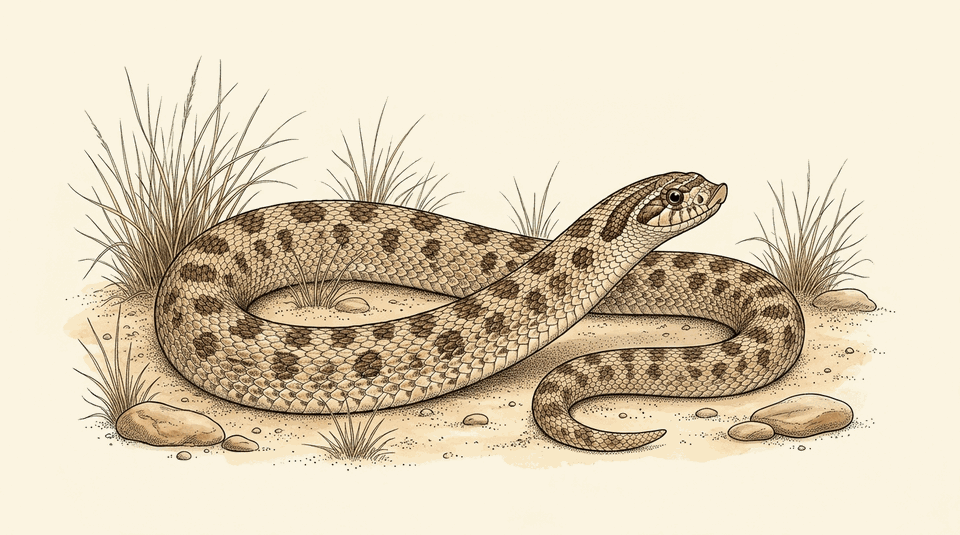
Hognose Snake
Heterodon nasicus
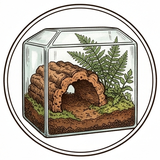
1. Deep Digging Bedding & Sunny Basking Spot
2. Two Great Ways to Set Up Your Habitat
Bedding: Shredded Aspen vs. Prairie Soil-Sand Mix
Hognoses spend half their day plowing tunnels with their upturned nose—give them 3–5 inches to dig in!
Option A: Shredded Aspen Snake Bedding (Our Favorite)
Holds fluffy tunnels like magic, stays bone-dry to prevent belly scale rot, and makes finding dropped pinky mice and poop super easy.
Option B: 70% Dry Reptile Soil + 30% Fine Sand Mix
Great for a natural prairie look! Let the top soil dry out and tuck our Powder Orange/Blue (P. pruinosus) or Dalmatian / Orange (P. scaber) Isopods + Springtails under a damp cork bark flat by the water dish.
Don't Put Babies in a Giant Empty Tank!
Little baby hognoses (especially boys!) will refuse food if they feel exposed in a huge open tank:
Option A: Cluttered 10- to 20-Gal Tank for Babies
Cover the bedding with flat cork bark pieces, fake leaves, and 3 tiny hides so your baby can sneak across the tank without being seen.
Option B: Size Up as They Grow
Males stay pint-sized (15–20") and love a 20-Gallon Long for life; females get twice as chunky (24–32") and step up to a 36"×18" tank.
Daytime Lighting (Standard & Albino Morphs)
Hognoses are daytime hunters that come alive under gentle overhead light:
Option A: 50W–75W Halogen Bulb + Leafy Shade
Gives them a 90°F sunbeam with cork flats and plants underneath (especially helpful for red-eyed Albino morphs that prefer dappled shade!).
Option B: Basking Bulb + Low-Output Shade UVB (5%–6%)
Brings out their natural prairie colors and morph patterns while supporting daytime activity and appetite.
3. Feeding Guide & Rear-Fanged Etiquette
Tricks for a Picky Baby Hognose:
Many shy babies won't strike tongs—leave the warm pinky on a plastic lid!
Dip the mouse nose in water-packed tuna or salmon juice—works like magic!
Keeps your fingers from smelling like dinner
Cooling dips in autumn tell their brain it's winter nap time

4. Four Keys to a Happy, Thriving Hognose Snake
Don't Flinch at the Hiss!
Babies put on a big show flattening their neck and bluff-poking with their nose. If you pull your hand away every time they hiss, they learn hissing works! Scoop calmly from underneath and they chill right out.
Keep the Bedding Dry!
Wet or humid tanks give prairie hognoses belly scale blisters fast. Keep tank humidity at 30–50% and only put damp moss inside an enclosed shed box.
Protect That Cute Snout
Because they push with their nose, make sure your lid is clipped tight so they don't rub their upturned snout raw against loose wire.
Flat Cork Bark Slabs
Besides regular caves, lay 2 flat pieces of cork bark right on top of the aspen—hognoses love sleeping pancaked under flat bark!

Bring-Home Shopping Checklist
Tap items to check them off on your phone while you shop at Critter Cabana.
Tank & Deep Digging Bedding
Basking Heat & Thermostat
Snug Caves, Dish & Mice
Complete Reference Notes & Oregon Keeping Guide
common_name: "Western Hognose Snake"
species_name: "Heterodon nasicus"
category: "reptile"
difficulty: 2
hardiness: 4
diet_type: "carnivore"
adult_size: "Males 14-24 inches, Females 24-36 inches"
lifespan: "15-20 years"
origin: "North America (Great Plains)"
temperament: "dramatic, bluff-striker, terrestrial/fossorial"
nocturnal: false
social: "solitary"
min_enclosure: "36x18x18 inches"
last_updated: "2026-08-04"
author: "Critter Cabana & Gresham Pet Supply"
version: "1.0"
wiki_synced: false
Species: Heterodon nasicus | Difficulty: 2/5 — Easy | Hardiness: 4/5 — Hardy
Critter Cabana & Gresham Pet Supply — Keeping Your Pet Healthy & Thriving
At a Glance
| Common Name | Western Hognose Snake, Plains Hognose Snake |
| Species | Heterodon nasicus |
| Origin | North America (Texas up through the Great Plains to Canada) |
| Adult Size | Males: 14–24 inches (much smaller) / Females: 24–36 inches (heavy-bodied) |
| Lifespan | 15–20 years |
| Diet Type | Carnivore (Frozen/Thawed Mice) |
| Activity | Diurnal (active during the day) |
| Temperament | Dramatic and highly defensive, but rarely bites. Known for mock-striking (bluffing). |
| Handleability | Easy to handle once picked up, though they may throw a tantrum first. |
| Social Needs | Strictly solitary. |
| Difficulty | 2/5 — Easy (Excellent beginner snake, though they can be picky eaters) |
| Hardiness | 4/5 — Hardy (Tolerates handling and minor husbandry errors well) |
Why We Love Them: The Western Hognose is famous for its upturned "hog" nose, which it uses like a shovel to dig in the dirt. They are the drama queens of the snake world, known for flattening their necks like a cobra, hissing loudly, and even playing dead (thanatosis) if they feel threatened!
VENOM & BITE RISK: Western Hognose snakes are technically rear-fanged venomous. Their venom is designed to subdue amphibians and is considered medically insignificant to humans (similar to a bee sting). They are not dangerous. They rarely bite defensively (they prefer to "bluff strike" with a closed mouth). However, if they mistake your finger for food and latch on, do not let them "chew," as that is how they deliver the mild venom. Wash with soap and water if bitten; mild localized swelling/itching may occur.
Notable Morphs & Locales
- Locales: While widely found across the Great Plains (from Texas up to Canada), the hobby rarely distinguishes by wild locale.
- Conda (Anaconda): A highly popular co-dominant morph that dramatically reduces the busy pattern on their back into a series of large, distinct spots and completely blacks out their belly.
- Super Conda: The homozygous version of Conda, resulting in a completely patternless, solid-colored snake with a black belly.
- Albino: Replaces all black/brown pigment with bright yellows, oranges, and reds.
Housing & Enclosure
Enclosure Size
- Juveniles: A 10 to 20-gallon long terrarium is sufficient for a baby.
- Adult Minimum Enclosure: 36" Long x 18" Wide x 18" High (approx. 40-50 gallons).
- Style: Glass terrarium with front-opening doors and a secure locking screen lid. Hognose snakes are terrestrial (ground-dwelling) and fossorial (burrowing), so floor space is the absolute priority.
Enclosure Setup
- Substrate: Deep substrate is non-negotiable. They are fossorial and spend a lot of time tunneling. Provide 3–5 inches of Aspen snake bedding, or a bioactive arid mix (Zilla Desert Mix / Zoo Med ReptiSoil mixed with playsand).
- Decor: Provide multiple tight, dark hides on both the warm and cool sides of the tank. Clutter the enclosure with fake plants and cork bark to make them feel secure.
- Humid Hide: Provide an enclosed hide box stuffed with damp sphagnum moss to help them shed cleanly, especially in dry climates.
Humidity & Water
- Humidity: Low to moderate (30%–50%). Standard room humidity is usually perfect.
- Misting: Do not mist the enclosure; wet substrate will cause scale rot and respiratory infections. Only the inside of the humid hide should be damp.
- Water Source: Provide a shallow water dish large enough for the snake to soak its body in. Clean and replace the water every 2 days.
Temperature & Lighting
- Warm Side / Basking Spot: 88–95°F (31–35°C). Use an under-tank heating pad regulated by a thermostat, or a ceramic heat emitter/halogen bulb.
- Cool Side Ambient: 75–80°F (24–27°C).
- Nighttime Drop: Can safely drop to 70°F (21°C).
- Lighting: Since they are diurnal (active by day), provide a standard daylight LED. Low-level UVB (Zone 1) is optional but highly beneficial for their immune system and natural behavior.
Diet & Nutrition
Primary Diet
- Food Type: Frozen/Thawed mice. Never feed live rodents, as mice can bite and severely injure the snake.
- Prey Size: The mouse should be slightly larger than the thickest part of the snake's body. Hognoses have shorter faces than other snakes, so err on the side of slightly smaller prey if in doubt.
- Feeding Frequency:
- Juveniles: Every 4–5 days.
- Adults: Every 7–10 days.
Picky Eater Troubleshooting
In the wild, Hognose snakes eat toads and amphibians, not mice. Because of this, they are notoriously picky eaters, especially as babies or during winter (brumation). If your Hognose refuses to eat:
- Check Husbandry: Is the basking spot hot enough (90°F+)? Is the tank too empty (causing stress)?
- Scenting: Thaw the mouse and rub it with a piece of tuna (canned in water, not oil), salmon, or a specialized toad scenting liquid. This tricks the snake into thinking the mouse is an amphibian.
- Drop Feeding: Place the mouse in a small cardboard tube or directly in front of the hide and leave the snake completely alone in a dark room overnight. Hognoses are easily distracted and may strike out of fear rather than hunger if you watch them.
- Brain the Mouse: Puncturing the skull of the thawed mouse exposes the scent of the brain, which often triggers a strong feeding response.
Socialization & Behavior
Handling
- Approach: Always approach from the side, never directly from above (which mimics a predator). Support their heavy bodies from underneath.
- The Tantrum: When first approached, a Hognose may hiss violently, flatten its neck, and "strike." Look closely—they usually strike with their mouth closed (a bluff strike). Once scooped up into your hands, they almost instantly calm down and stop bluffing.
- Frequency: Handle for 10-15 minutes a day to tame them, but do not handle for 48 hours after feeding to prevent regurgitation.
Health & Husbandry

Common Health Issues
- Regurgitation — Cause: Handling too soon after feeding, or the basking spot is not hot enough for them to digest the meal. / Prevention: Leave them alone for 48 hours post-feed and check temps.
- Respiratory Infection (RI) — Symptoms: Wheezing, clicking noises when breathing, bubbles or mucus blowing from the nose, holding the head straight up. / Cause: High humidity, wet substrate, or cold temperatures. / Treatment: Requires an exotic vet for antibiotics.
- Scale Rot — Symptoms: Brown, crusty, or blistered scales on the belly. / Cause: Sitting in wet, dirty substrate. / Treatment: Move to paper towels, clean with Betadine, and see a vet.
What We Stock & Use in Our Stores
These are products we actively carry and recommend for Plains Hognose Snake setups. Ask any associate for help finding them in-store.
| Category | Product | Notes |
|---|---|---|
| Enclosure | Exo Terra Natural Terrarium (Large/Low 36x18x18) | Perfect footprint for adult Hognoses |
| Substrate | Zilla Snake & Lizard Litter (Aspen) | Best for holding deep tunnels |
| Heating | Zilla Heat Mat + Zilla Terrarium Heat & Habitat Controller | CRITICAL: Always use a thermostat |
| Hides | Zilla Rock Lair | An excellent humid hide to aid in shedding |
| Lighting | Exo Terra Reptile UVB100 | Provides beneficial low-level UVB |
| Water Dish | Exo Terra Water Dish (Medium or Large) | Sturdy and difficult to tip over |
| Water Treatment | Zoo Med ReptiSafe Water Conditioner | Removes chlorine from tap water |
Care sheet compiled by Critter Cabana & Gresham Pet Supply. For questions, ask any livestock specialist in-store.
Last updated: 2026-08-04
How We Keep Them at Critter Cabana & Gresham Pet Supply
- Beating Dry Oregon Furnace Air (and Summer Heat Spikes): Across the Willamette Valley and Portland Metro, running the house furnace all winter drops indoor humidity to 25–35%, which quickly causes stuck sheds and dehydration in screen-top tanks. To hold
balanced humidityreliably for Hognose Snake, our crew uses a deep 3–5" substrate bed (or our store-shelf 10-Part Bioactive Mix of ReptiSoil, Coco Fiber, Orchiata Bark, Sphagnum Moss, and Leaf Litter), a dedicated humid hide packed with damp sphagnum moss, and partial screen cover when needed. - Thermostat & Linear UVB Standard: Every heating element in our Newberg and Gresham reptile rooms runs on a thermostat probe set to
species-appropriate warm zoneon the warm side with acomfortable room temperaturecool retreat, paired withspecies-appropriate lightingon a 12-hour day/night timer. In summer, if an upstairs room climbs above 82°F, a dimming thermostat automatically backs down the basking lamp so the cool side never overheats. - Stocked at Newberg & Gresham: We stock reptile enclosures, thermostats, Arcadia & Zoo Med UVB lighting, bioactive substrate ingredients, live Springtails, Dwarf White, Powder Blue/Orange, Dairy Cow, and Giant Canyon isopods, and gut-loaded crickets, dubia roaches, hornworms, and frozen-thawed rodents at Critter Cabana (Newberg) and Gresham Pet Supply.
Common Questions (FAQ)
What size tank does an adult Hognose Snake actually need?
An adult Hognose Snake needs at least an appropriately sized enclosure so you can maintain a true thermal gradient from species-appropriate warm zone on the warm/basking side down to comfortable room temperature on the cool side.
How do I keep Hognose Snake humidity at balanced humidity during dry Oregon winters?
Oregon winter furnace heat dries out thin bedding fast. Use a 3–5 inch moisture-retaining substrate mix (such as Zoo Med ReptiSoil blended with coco fiber, Orchiata bark, and sphagnum moss), provide an enclosed humid hide, and cover 50–70% of an open screen top with HVAC foil tape or a PVC panel if ambient humidity drops too low.
What is the best bioactive clean-up crew for a Hognose Snake?
Pair Temperate White Springtails with a humidity-matched isopod species (such as Powder Blue/Orange for semi-arid setups or Dwarf White / Dairy Cow isopods for humid forest setups) in a 3–5 inch bioactive soil and leaf-litter bed. You can pick up our 1-Page or Tri-Fold Bioactive Substrate Recipe Guide and live cultures at Critter Cabana (Newberg) or Gresham Pet Supply.
Where can I get Hognose Snake setup supplies, live feeders, and thermostats in Oregon?
We stock our full reptile, amphibian, and bioactive setup supplies—including enclosures, thermostats, Arcadia and Zoo Med UVB lighting, bioactive substrates, live isopods/springtails, and live or frozen feeders—at Critter Cabana in Newberg (514 E First St, 503-537-2887) and Gresham Pet Supply (2185 NW Burnside Rd, 503-665-7606).