
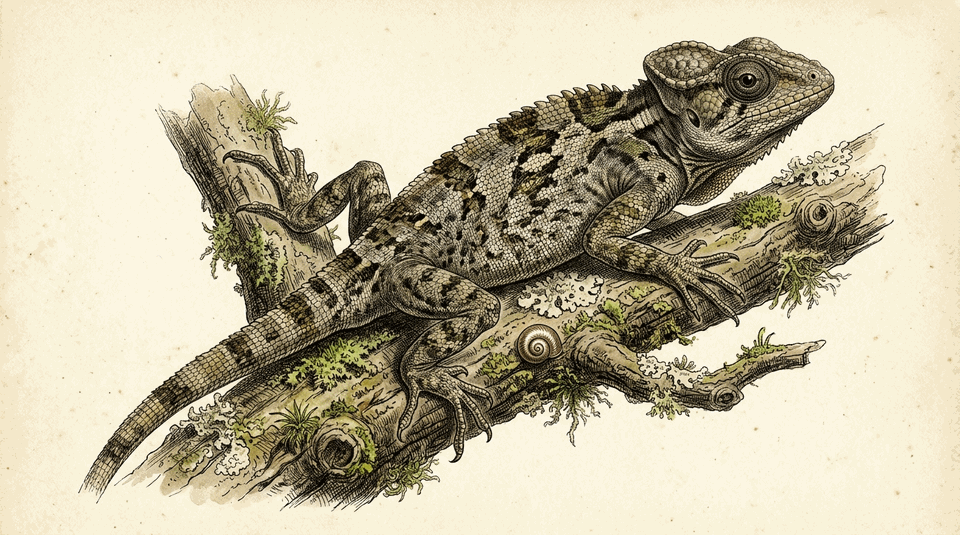
Veiled Chameleon
Chamaeleo calyptratus
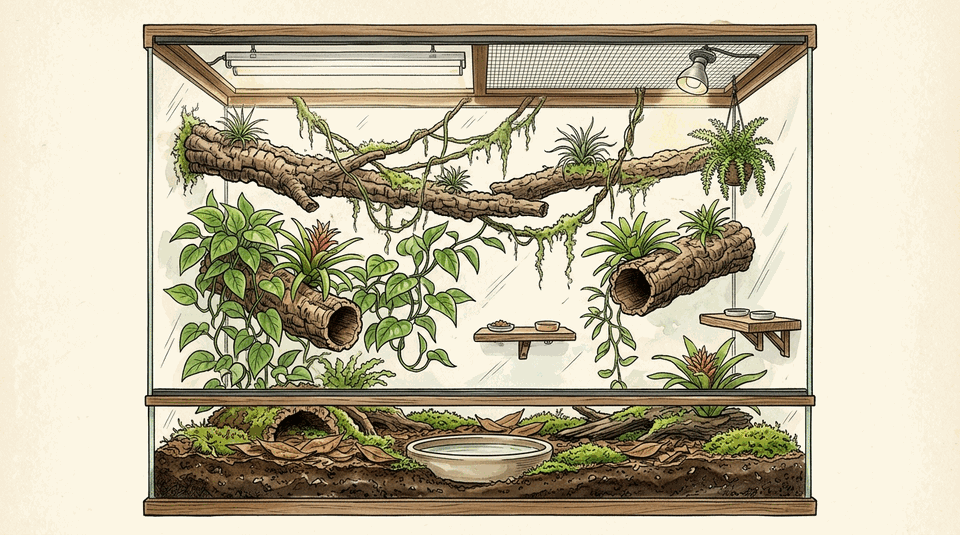
1. Habitat Layout & Temperature Gradient
Species: Chamaeleo calyptratus | Difficulty: 4/5 — Advanced | Hardiness: 2/5 — Delicate

Critter Cabana & Gresham Pet Supply — Keeping Your Pet Healthy & Thriving
At a Glance

| Common Name | Veiled Chameleon, Yemen Chameleon |
| Species | Chamaeleo calyptratus |
| Origin | Yemen and Saudi Arabia (coastal mountain slopes and valleys) |
| Adult Size | Males: up to 24 inches / Females: 14–18 inches |
| Lifespan | Males: 5–8 years / Females: 3–5 years (due to reproductive stress) |
| Diet Type | Insectivore (will occasionally eat leafy greens) |
| Activity | Diurnal (active during the day) |
| Temperament | Territorial, display-only pet. Easily stressed. |
| Handleability | Poor — handling causes chronic stress leading to immune suppression. |
| Habitat Type | Arboreal (strictly tree-dwelling) |
| Difficulty | 4/5 — Advanced |
| Hardiness | 2/5 — Delicate |
Before You Buy: Chameleons are incredibly rewarding, but they are not beginner pets. They are sensitive to stress, require highly specific lighting and hydration setups (they don't drink from bowls), and must be housed in screen enclosures. They are strict "observation-only" pets.
Housing & Enclosure
Enclosure Type & Size
- Type: Screen Enclosure REQUIRED. Glass tanks cause stagnant, humid air which rapidly leads to fatal respiratory infections.
- Minimum for Adults: 24" x 24" x 48" (Width x Depth x Height). Height is absolutely critical.
- Minimum for Juveniles: 16" x 16" x 30" (moving them to the adult size at around 6-8 months).
- Enclosure Recommendations: Zoo Med ReptiBreeze (XL).
Substrate
- Recommended: Bare floor or paper towels.
- Avoid: ALL loose substrates (soil, bark, moss, sand). Chameleons shoot their sticky tongues to catch prey; if they hit the ground, they will ingest the substrate, causing lethal impaction.
Décor & Enrichment
- Vines & Branches: Fill the top half of the enclosure with horizontal and diagonal climbing vines of varying thicknesses.
- Live Plants: Highly recommended for humidity retention and drinking surfaces. Must be non-toxic, as veiled chameleons will chew on leaves.
- Safe plants: Pothos, Ficus benjamina, Schefflera (Umbrella Tree), Hibiscus.
- Wash all plants thoroughly and repot in organic topsoil to remove pesticides before putting them in the tank.
- Placement: The highest basking branch should be 6-8 inches below the heat and UVB lamps.
Temperature
Chameleons regulate their body temperature by moving vertically.
| Zone | Temperature |
|---|---|
| Basking Branch | 85–95°F (29–35°C) |
| Ambient/Cool (Bottom) | 72–80°F (22–27°C) |
| Nighttime Drop | 65–70°F (18–21°C) — A nighttime drop is highly beneficial. |
Heating
- Primary: Low-wattage incandescent or halogen bulb placed in a dome fixture resting on top of the screen.
- CRITICAL: Use a digital thermometer with a probe placed directly on the basking branch to ensure it does not exceed 95°F. Chameleons will sit under a light that is too hot until they suffer severe thermal burns.
Humidity & Hydration (CRITICAL)
Chameleons DO NOT drink from standing water bowls. They only drink moving water droplets off leaves.
- Daytime Humidity: 30–50%. The cage must dry out during the day.
- Nighttime Humidity: 80–100%. Use a cool-mist fogger at night.
- Hydration Methods:
- Dripper: A "Little Dripper" constantly dripping water onto a broad leaf throughout the day.
- Misting: Heavily mist the enclosure with a pump sprayer or automated misting system for 2-3 minutes at dawn and dusk.
Lighting (CRITICAL: UVB)
- Photoperiod: 12 hours on / 12 hours off.
- UVB: ABSOLUTELY REQUIRED. Without proper UVB, they will develop Metabolic Bone Disease (MBD) and die.
- Type: You MUST use a Linear T5 HO (High Output) 5.0 tube that spans the width of the enclosure. Compact coil bulbs do not penetrate deep enough into the screen cage.
- Replacement: Replace the UVB tube every 6-12 months.
Diet & Nutrition

Feeding Schedule
| Life Stage | Frequency | Amount |
|---|---|---|
| Juvenile (<6 mos) | Daily | As many small insects as they can eat in 15 mins (10-15) |
| Sub-adult (6-12 mos) | Every other day | 6–8 medium insects |
| Adult (1+ years) | Every other day | 5–6 large insects (watch for obesity) |
Prey Items
- Staples: Crickets, Dubia roaches, silkworms, black soldier fly larvae (Nutrigrubs).
- Treats (Sparingly): Hornworms (excellent for hydration), superworms.
- Greens: Veiled chameleons are unique in that they occasionally eat vegetation. Offer a clipped leaf of collard greens or mustard greens once a week.
- Size Rule: Insects should be no wider than the space between the chameleon's eyes.
Supplements (The Dusting Schedule)
Proper supplementation is a delicate balance. Over-supplementing Vitamin D3 is just as toxic as under-supplementing.
- Calcium WITHOUT D3: Dust insects lightly at every feeding.
- Calcium WITH D3: Dust insects lightly only 2 times per month.
- Multivitamin (with Vitamin A): Dust insects lightly only 2 times per month (alternate weeks with the D3).
Gut-Loading
- Feed insects a highly nutritious diet (carrots, sweet potatoes, squash, dark leafy greens) 24 hours before feeding them to the chameleon. "You are what your food eats."
Health & Husbandry

Common Health Issues
- Metabolic Bone Disease (MBD) — Symptoms: Bowed/rubbery legs, inability to grip branches, crooked jaw, tongue shooting fails. / Cause: Lack of T5 UVB lighting or lack of dietary calcium. / Prevention: Strict adherence to lighting and supplement schedules.
- Dehydration / Sunken Eyes — Symptoms: The eyes appear sunken into the turrets, urates (the white part of the poop) are yellow or orange instead of pure white. / Cause: Lack of dripping/misting water. / Treatment: Increase misting durations; run a dripper directly over the chameleon.
- Respiratory Infection (RI) — Symptoms: Pointing nose up in the air, gaping mouth, wheezing, excessive mucus. / Cause: Housed in a glass tank (stagnant air) or enclosure staying soaking wet all day. Requires immediate vet care and antibiotics.
- Egg Binding (Dystocia in Females) — Female veiled chameleons will lay eggs even if they have never seen a male. If they do not have a proper laying bin (a 12-inch deep bucket of moist sand/soil mix placed at the bottom of the cage), they will hold the eggs until they die.
Shedding
- Chameleons shed in flaky patches. It should complete within a day or two. Ensure humidity spikes at night to help with the process. Never peel the skin.
Veterinary Needs
- Locate an exotics veterinarian before you buy a chameleon. They hide illnesses exceptionally well; by the time they look sick, it is often a medical emergency.
Morphs & Varieties
Veiled chameleons do not have true, localized morphs like Panther Chameleons.
- "Sunburst" / "High Yellow" / "Turquoise": These are marketing terms (designer names) for selectively bred chameleons showing brighter greens, yellows, or blues. They are not true genetic morphs.
- Translucent (Hypo/Trans): A true genetic mutation where the skin lacks white pigment, making it slightly see-through. They often look paler or slightly pinkish-green.
- Piebald (Pied): A genetic mutation causing random patches of bright white, unpigmented skin across the body, contrasting with the normal green coloration.
Handling Guidelines
- Look, Don't Touch: Chameleons are easily stressed by handling. Chronic stress suppresses their immune system, leading to illness.
- The "Treadmill": If you must handle them (for cage cleaning or health checks), coax them onto a stick or let them walk hand-over-hand.
- Never Grab: Never grab a chameleon around the body or pull them off a branch (they will break their own ribs or toes holding on).
- Color Meanings: A bright green, relaxed chameleon is happy. A chameleon showing dark blacks, browns, or intense spots is highly stressed, cold, or angry.
Compatibility
- Cohabitation: NEVER. Chameleons are fiercely territorial. Housing two together will result in the dominant one bullying the other through intimidation (hogging the heat/food) until the subordinate one dies of stress. Keep them strictly alone.
Oregon & Local Keeping Notes
- Oregon: Legal to own. No special permits required.
- General: Widely captive-bred and legal in most jurisdictions.
What We Stock & Use in Our Stores
These are products we carry and recommend for this species. Ask any associate for help finding them in-store.
| Category | Product | Notes |
|---|---|---|
| Enclosure | Zoo Med ReptiBreeze (24x24x48) | Screen is mandatory |
| Hydration | Zoo Med Little Dripper | Run daily over live plants |
| Misting | Exo Terra Spray Bottle or MistKing | Mist 2x daily (morning/night) |
| Heating | Zoo Med Basking Spot Lamp | Use with dome on top of screen |
| Thermometer | Exo Terra Digital Thermometer with Probe | Place probe on basking branch |
| UVB Lighting | Zoo Med ReptiSun T5 HO 5.0 Terrarium Hood | ABSOLUTELY REQUIRED (Linear tube) |
| Calcium (No D3) | Zoo Med Repti Calcium (without D3) | Use at every feeding |
| Calcium (With D3) | Zoo Med Repti Calcium (with D3) | Use 2x a month |
| Vitamins | Zoo Med Reptivite | Use 2x a month |
| Vines | Exo Terra Jungle Vines | Bendable, easy to grip |
Care sheet compiled by Critter Cabana & Gresham Pet Supply. For questions, ask any reptile specialist in-store.
Last updated: 2026-08-04
How We Keep Them at Critter Cabana & Gresham Pet Supply
- Beating Dry Oregon Furnace Air (and Summer Heat Spikes): Across the Willamette Valley and Portland Metro, running the house furnace all winter drops indoor humidity to 25–35%, which quickly causes stuck sheds and dehydration in screen-top tanks. To hold
30-100%reliably for Veiled Chameleon, our crew uses a deep 3–5" substrate bed (or our store-shelf 10-Part Bioactive Mix of ReptiSoil, Coco Fiber, Orchiata Bark, Sphagnum Moss, and Leaf Litter), a dedicated humid hide packed with damp sphagnum moss, and partial screen cover when needed. - Thermostat & Linear UVB Standard: Every heating element in our Newberg and Gresham reptile rooms runs on a thermostat probe set to
85-95°Fon the warm side with a72-80°Fcool retreat, paired withrequiredon a 12-hour day/night timer. In summer, if an upstairs room climbs above 82°F, a dimming thermostat automatically backs down the basking lamp so the cool side never overheats. - Stocked at Newberg & Gresham: We stock reptile enclosures, thermostats, Arcadia & Zoo Med UVB lighting, bioactive substrate ingredients, live Springtails, Dwarf White, Powder Blue/Orange, Dairy Cow, and Giant Canyon isopods, and gut-loaded crickets, dubia roaches, hornworms, and frozen-thawed rodents at Critter Cabana (Newberg) and Gresham Pet Supply.
Common Questions (FAQ)
What size tank does an adult Veiled Chameleon actually need?
An adult Veiled Chameleon needs at least 24x24x48 inches so you can maintain a true thermal gradient from 85-95°F on the warm/basking side down to 72-80°F on the cool side.
How do I keep Veiled Chameleon humidity at 30-100% during dry Oregon winters?
Oregon winter furnace heat dries out thin bedding fast. Use a 3–5 inch moisture-retaining substrate mix (such as Zoo Med ReptiSoil blended with coco fiber, Orchiata bark, and sphagnum moss), provide an enclosed humid hide, and cover 50–70% of an open screen top with HVAC foil tape or a PVC panel if ambient humidity drops too low.
What is the best bioactive clean-up crew for a Veiled Chameleon?
Pair Temperate White Springtails with a humidity-matched isopod species (such as Powder Blue/Orange for semi-arid setups or Dwarf White / Dairy Cow isopods for humid forest setups) in a 3–5 inch bioactive soil and leaf-litter bed. You can pick up our 1-Page or Tri-Fold Bioactive Substrate Recipe Guide and live cultures at Critter Cabana (Newberg) or Gresham Pet Supply.
Where can I get Veiled Chameleon setup supplies, live feeders, and thermostats in Oregon?
We stock our full reptile, amphibian, and bioactive setup supplies—including enclosures, thermostats, Arcadia and Zoo Med UVB lighting, bioactive substrates, live isopods/springtails, and live or frozen feeders—at Critter Cabana in Newberg (514 E First St, 503-537-2887) and Gresham Pet Supply (2185 NW Burnside Rd, 503-665-7606).