
Carpet Python
Morelia spilota (Coastal, Jungle & Irian Jaya)

1. Semi-Arboreal Habitat & Thermal Gradient
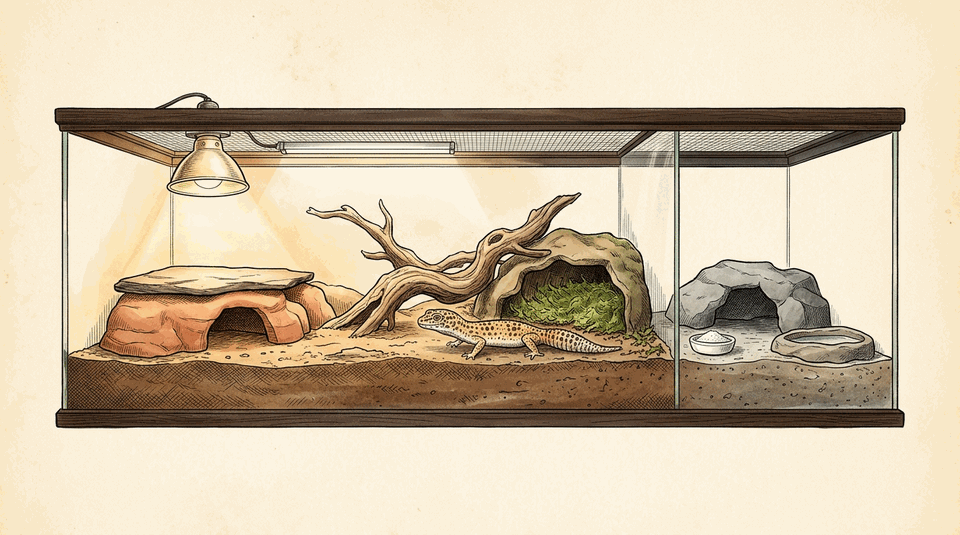

2. Two Great Ways to Set Up Your Habitat
Substrate: Moisture-Retentive Forest Bedding
Holds 50–65% humidity without staying swampy.
Option A: Forest Floor & ReptiBark
3"–4" blend of Zoo Med Forest Floor Cypress Mulch and ReptiBark. Spot-clean weekly.
Option B: Living Bioactive Forest Bed
4" mix of Reptisoil + ReptiBark + Eco Earth + Sphagnum topped with leaf litter, seeded with Powder Orange Isopods (P. pruinosus) & Springtails.
Heating & Perches: Overhead Radiant Heat
Semi-arboreal pythons bask on elevated branches and ledges.
Option A: Halogen Day Bulb + CHE Night Heat
Zoo Med Repti Tuff Halogen on a dimmer/thermostat for daytime basking + Ceramic Heat Emitter for lightless night warmth.
Option B: Deep Heat Projector + ShadeDweller UVB
Arcadia Deep Heat Projector on a digital thermostat + Arcadia ShadeDweller T5 UVB + sturdy Ghostwood/Cork branches.

3. Diet & Frozen/Thawed Feeding Schedule
Feeding & Handling Rules
Transition to rats early; size prey to 1x the snake's widest body diameter.
Large enough for soaking, placed on the cool side and refreshed daily with Reptisafe.
Never handle for 48 hours after a meal so digestion proceeds smoothly without regurgitation.
Carpet Pythons have a strong feeding response; always use 12"–18" hemostats/tongs.

4. Four Keys to a Happy, Thriving Carpet Python
Sturdy Horizontal Perches
Secure thick driftwood, cork tubes, or PVC perches across the enclosure — Carpet Pythons spend over half their time elevated.
Locking Escape-Proof Lid
Pythons are strong pushers; always use heavy-duty screen clips or locking front-opening doors.
Thermostat on Every Heat Source
Never run a heat mat, CHE, or DHP unregulated — plug every heating element into a digital thermostat.
Confident Hook/Tap Training
Touch gently with a paper towel roll or snake hook before picking up so your python knows it is handling time, not feeding time.

Bring-Home Shopping Checklist
Tap items to check them off on your phone while you shop at Critter Cabana.
Enclosure & Heating
Substrate & Climbing
Feeding & Care
Complete Reference Notes & Oregon Keeping Guide
Semi-Arboreal Habitat & Thermal Gradient

Key Rule: Carpet Pythons love climbing! Provide sturdy horizontal branches at basking height plus snug hides on both the warm and cool floor.
Temperature & Humidity Zones
| Zone | Target | Notes |
|---|---|---|
| Warm Basking Branch / Shelf | 88°–92°F | Controlled by thermostat probe on warm perch |
| Warm Hide & Ambient | 82°–85°F | Ground hide under warm side |
| Cool Side Hide & Water Bowl | 75°–78°F | Opposite end of enclosure |
| Nighttime Ambient | 72°–76°F | Use ceramic heat emitter or DHP (no red light) |
| Ambient Humidity & Shed Boost | 50–65% RH | Mist lightly; provide damp sphagnum humid hide |
Two Ways That Work (100% Stocked Store Options)
Substrate: Moisture-Retentive Forest Bedding
Holds 50–65% humidity without staying swampy.
- Option A: Forest Floor & ReptiBark: 3"–4" blend of Zoo Med Forest Floor Cypress Mulch and ReptiBark. Spot-clean weekly.
- Option B: Living Bioactive Forest Bed: 4" mix of Reptisoil + ReptiBark + Eco Earth + Sphagnum topped with leaf litter, seeded with Powder Orange Isopods (P. pruinosus) & Springtails.
Heating & Perches: Overhead Radiant Heat
Semi-arboreal pythons bask on elevated branches and ledges.
- Option A: Halogen Day Bulb + CHE Night Heat: Zoo Med Repti Tuff Halogen on a dimmer/thermostat for daytime basking + Ceramic Heat Emitter for lightless night warmth.
- Option B: Deep Heat Projector + ShadeDweller UVB: Arcadia Deep Heat Projector on a digital thermostat + Arcadia ShadeDweller T5 UVB + sturdy Ghostwood/Cork branches.
Diet & Frozen/Thawed Feeding Schedule
100% Frozen/Thawed Rodents: Thaw in warm water until ~98°F and offer with long feeding tongs in the evening.
- Hatchling / Juvenile (Every 7 Days): Fuzzy to Hopper mice or rat pups matching the thickest part of the snake's midsection.
- Sub-Adult (3–5 ft) (Every 10–14 Days): Weaned to Small/Medium rats thawed thoroughly to body temperature.
- Adult (5–8 ft) (Every 14–21 Days): Medium to Large rats; avoid overfeeding to keep body condition lean and muscular.
Feeding & Handling Rules
- Frozen/Thawed Rats & Mice: Transition to rats early; size prey to 1x the snake's widest body diameter.
- Heavy Ceramic Water Bowl: Large enough for soaking, placed on the cool side and refreshed daily with Reptisafe.
- Wait 48 Hours After Eating: Never handle for 48 hours after a meal so digestion proceeds smoothly without regurgitation.
- Use Long Feeding Tongs: Carpet Pythons have a strong feeding response; always use 12"–18" hemostats/tongs.
Keeper Note: No calcium dusting is needed on whole vertebrate prey (rodents already contain balanced bone calcium and organs).
Essential Keeper Rules & Pro Tips
- Sturdy Horizontal Perches: Secure thick driftwood, cork tubes, or PVC perches across the enclosure — Carpet Pythons spend over half their time elevated.
- Locking Escape-Proof Lid: Pythons are strong pushers; always use heavy-duty screen clips or locking front-opening doors.
- Thermostat on Every Heat Source: Never run a heat mat, CHE, or DHP unregulated — plug every heating element into a digital thermostat.
- Confident Hook/Tap Training: Touch gently with a paper towel roll or snake hook before picking up so your python knows it is handling time, not feeding time.
Complete Store Setup Checklist
Enclosure & Heating
- 40-Gal Breeder / 36"x18"x18" (Juv) or 4x2x2+ Adult Enclosure
- Digital Thermostat + Dual Digital Thermometer/Hygrometer
- Overhead Basking Bulb / Deep Heat Projector + Ceramic Dome
- Optional 5%–7% T5 UVB Linear Fixture
Substrate & Climbing
- Zoo Med Forest Floor Cypress Mulch + ReptiBark (or Reptisoil Bioactive Mix)
- 2–3 Sturdy Horizontal Climbing Branches / Cork Bark Tubes
- 2 Snug Cave Hides (1 Warm Side, 1 Cool Side) + Sphagnum Moss
- Heavy Tip-Proof Ceramic Water Dish
Feeding & Care
- Appropriately Sized Frozen Mice / Rats
- 12"–18" Stainless Steel Feeding Tongs
- Zoo Med Reptisafe Water Conditioner
- Zoo Med Wipe Out Terrarium Disinfectant
How We Keep Them at Critter Cabana & Gresham Pet Supply
- Beating Dry Oregon Furnace Air (and Summer Heat Spikes): Across the Willamette Valley and Portland Metro, running the house furnace all winter drops indoor humidity to 25–35%, which quickly causes stuck sheds and dehydration in screen-top tanks. To hold
50–65% RHreliably for Carpet Python, our crew uses a deep 3–5" substrate bed (or our store-shelf 10-Part Bioactive Mix of ReptiSoil, Coco Fiber, Orchiata Bark, Sphagnum Moss, and Leaf Litter), a dedicated humid hide packed with damp sphagnum moss, and partial screen cover when needed. - Thermostat & Linear UVB Standard: Every heating element in our Newberg and Gresham reptile rooms runs on a thermostat probe set to
88°–92°Fon the warm side with a72°–76°Fcool retreat, paired withRecommended (5%–6% Shade T5 UVB)on a 12-hour day/night timer. In summer, if an upstairs room climbs above 82°F, a dimming thermostat automatically backs down the basking lamp so the cool side never overheats. - Stocked at Newberg & Gresham: We stock reptile enclosures, thermostats, Arcadia & Zoo Med UVB lighting, bioactive substrate ingredients, live Springtails, Dwarf White, Powder Blue/Orange, Dairy Cow, and Giant Canyon isopods, and gut-loaded crickets, dubia roaches, hornworms, and frozen-thawed rodents at Critter Cabana (Newberg) and Gresham Pet Supply.
Common Questions (FAQ)
What size tank does an adult Carpet Python actually need?
An adult Carpet Python needs at least 40B (Juv) → 4x2x2+ so you can maintain a true thermal gradient from 88°–92°F on the warm/basking side down to 72°–76°F on the cool side.
How do I keep Carpet Python humidity at 50–65% RH during dry Oregon winters?
Oregon winter furnace heat dries out thin bedding fast. Use a 3–5 inch moisture-retaining substrate mix (such as Zoo Med ReptiSoil blended with coco fiber, Orchiata bark, and sphagnum moss), provide an enclosed humid hide, and cover 50–70% of an open screen top with HVAC foil tape or a PVC panel if ambient humidity drops too low.
What is the best bioactive clean-up crew for a Carpet Python?
Pair Temperate White Springtails with a humidity-matched isopod species (such as Powder Blue/Orange for semi-arid setups or Dwarf White / Dairy Cow isopods for humid forest setups) in a 3–5 inch bioactive soil and leaf-litter bed. You can pick up our 1-Page or Tri-Fold Bioactive Substrate Recipe Guide and live cultures at Critter Cabana (Newberg) or Gresham Pet Supply.
Where can I get Carpet Python setup supplies, live feeders, and thermostats in Oregon?
We stock our full reptile, amphibian, and bioactive setup supplies—including enclosures, thermostats, Arcadia and Zoo Med UVB lighting, bioactive substrates, live isopods/springtails, and live or frozen feeders—at Critter Cabana in Newberg (514 E First St, 503-537-2887) and Gresham Pet Supply (2185 NW Burnside Rd, 503-665-7606).