Blue Tongue Skink
Tiliqua spp.
1. Habitat Layout & Temperature Gradient
Species: Tiliqua spp. | Difficulty: 2/5 — Easy | Hardiness: 4/5 — Hardy

Critter Cabana & Gresham Pet Supply — Keeping Your Pet Healthy & Thriving
At a Glance

| Common Name | Blue Tongue Skink (BTS) |
| Species | Tiliqua spp. (Northern, Indonesian, Merauke, Halmahera) |
| Origin | Australia (Northerns) and Indonesia |
| Adult Size | 18 to 24 inches (Heavy-bodied, sausage-shaped lizards) |
| Lifespan | 15 to 20 years |
| Diet Type | Omnivore (Insects, vegetables, wet dog food) |
| Activity | Diurnal (Active during the day) |
| Temperament | Often called the "golden retrievers" of the reptile world. Very smart, slow-moving, and docile. |
| Handleability | Excellent. They are heavy and move slowly, making them great for handling while sitting on the couch. Because they have very short legs, they must be fully supported from underneath. |
| Difficulty | 2/5 — Easy |
| Hardiness | 4/5 — Hardy |
Why We Love Them: Blue Tongue Skinks are incredibly intelligent and interactive. When threatened, they hiss loudly and stick out a massive, bright blue tongue to scare off predators. In captivity, they quickly learn to recognize their owners and are famous for their love of high-quality wet dog food!
Northern vs. Indonesian (Humidity Warning)

KNOW YOUR SUBSPECIES: There are two main groups of Blue Tongue Skinks in the pet trade, and they require completely different humidity levels:
- Australian (Northerns): Live in arid/semi-arid regions. Require 40% to 60% humidity.
- Indonesian (Halmahera, Merauke): Live in tropical rainforests. Require 70% to 80% humidity. Keeping an Indonesian at low humidity will cause severe respiratory infections and lost toes from stuck shed.
Housing & Enclosure
Enclosure Type & Size
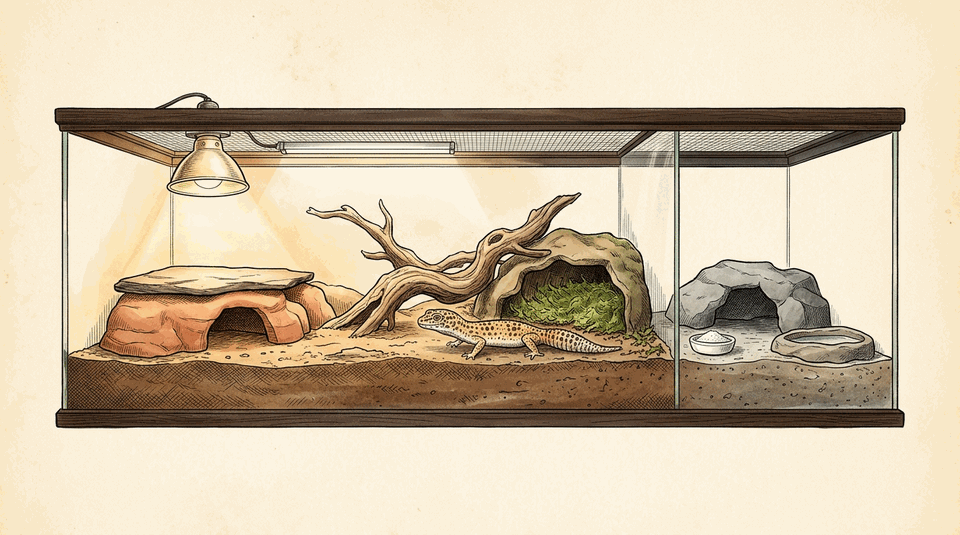
- Minimum Size: 4' x 2' x 2' (120 Gallon). They are highly active, terrestrial lizards that require a massive amount of floor space to roam.
- Type: PVC enclosures are highly recommended over glass tanks because they hold heat and humidity much better (especially for Indonesian species).
Substrate
- Depth: Provide 4 to 6 inches of substrate. They love to burrow and will often sleep completely submerged in the dirt.
- Recommended (Northerns): Aspen shavings, ReptiBark, or a dry organic topsoil mix.
- Recommended (Indonesians): Cypress mulch, coconut coir (EcoEarth), or a tropical bioactive mix that holds moisture.
Décor & Enrichment
- Hides: Provide large, sturdy hides on both the warm and cool ends. Cork bark flats are excellent, as they can squeeze underneath them to feel secure.
- Climbing: They have very short legs and are clumsy climbers. Keep climbing structures low to the ground to prevent fatal falls.
Heating & Lighting

Temperature Requirements
| Zone | Temperature |
|---|---|
| Basking Surface | 100–105°F (38–41°C) |
| Warm Ambient | 85–90°F (29–32°C) |
| Cool End | 75–80°F (24–26°C) |
| Nighttime Drop | 70–75°F (21–24°C) |
- Heating: A high-wattage halogen basking bulb is best to provide deep, penetrating heat. Use a temperature gun to measure the surface of the basking rock, not just the air temperature.
Lighting & UVB
- UVB (Mandatory): Like most diurnal lizards, they require UVB to synthesize Vitamin D3 and process calcium. A T5 HO linear UVB bulb (like the Arcadia 6% or 12%, depending on the enclosure height) should span half the length of the enclosure.
- Light Cycle: 12 hours on, 12 hours off.
Diet & Nutrition
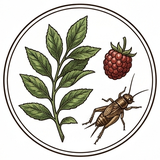
Blue Tongue Skinks are true omnivores. A balanced diet consists of 50% Vegetables / 40% Protein / 10% Fruit.
The "Dog Food" Diet
Unlike most reptiles, BTS thrive on a diet based around high-quality wet dog or cat food.
- Babies/Juveniles: High-quality, grain-free wet cat food (higher protein for growth). Feed daily.
- Adults: High-quality, grain-free wet dog food (Wellness Core, Instinct, Zignature). Feed every 2 to 3 days.
Vegetables & Greens (Mix into the dog food)
- Staples: Mustard greens, collard greens, dandelion greens, butternut squash.
- Avoid: Spinach (binds calcium), iceberg lettuce (no nutrition).
Live Insects & Snails (For enrichment)
- They love hunting! Offer Dubia roaches, hornworms, and superworms.
- Snails: Canned or live (pesticide-free) snails are a natural favorite. Their strong jaws are perfectly evolved to crush snail shells.
Supplements
- If feeding a varied diet with premium dog food, supplement lightly. Dust with Calcium (without D3, assuming you have UVB) once a week.
What We Stock & Use in Our Stores
These are products we carry and recommend for this species. Ask any associate for help finding them in-store.
| Category | Product | Notes |
|---|---|---|
| Lighting | Arcadia T5 HO UVB Kit (6% or 12%) | Essential for preventing Metabolic Bone Disease |
| Heating | Zoo Med Basking Spot Lamp | Creates the 100F+ basking zone |
| Substrate | Zoo Med Forest Floor (Cypress Mulch) | Excellent for Indonesian humidity needs |
| Diet | Zoo Med Can O' Snails | The ultimate high-value treat for a BTS |
Care sheet compiled by Critter Cabana & Gresham Pet Supply. For questions, ask any livestock specialist in-store.
Last updated: 2026-08-04
How We Keep Them at Critter Cabana & Gresham Pet Supply
- Beating Dry Oregon Furnace Air (and Summer Heat Spikes): Across the Willamette Valley and Portland Metro, running the house furnace all winter drops indoor humidity to 25–35%, which quickly causes stuck sheds and dehydration in screen-top tanks. To hold
Species dependent (40% to 80%)reliably for Blue Tongue Skink, our crew uses a deep 3–5" substrate bed (or our store-shelf 10-Part Bioactive Mix of ReptiSoil, Coco Fiber, Orchiata Bark, Sphagnum Moss, and Leaf Litter), a dedicated humid hide packed with damp sphagnum moss, and partial screen cover when needed. - Thermostat & Linear UVB Standard: Every heating element in our Newberg and Gresham reptile rooms runs on a thermostat probe set to
Basking 100-105°F / Cool 75-80°Fon the warm side with acomfortable room temperaturecool retreat, paired withtrueon a 12-hour day/night timer. In summer, if an upstairs room climbs above 82°F, a dimming thermostat automatically backs down the basking lamp so the cool side never overheats. - Stocked at Newberg & Gresham: We stock reptile enclosures, thermostats, Arcadia & Zoo Med UVB lighting, bioactive substrate ingredients, live Springtails, Dwarf White, Powder Blue/Orange, Dairy Cow, and Giant Canyon isopods, and gut-loaded crickets, dubia roaches, hornworms, and frozen-thawed rodents at Critter Cabana (Newberg) and Gresham Pet Supply.
Common Questions (FAQ)
What size tank does an adult Blue Tongue Skink actually need?
An adult Blue Tongue Skink needs at least 4x2x2 PVC or 120-Gallon Terrarium so you can maintain a true thermal gradient from Basking 100-105°F / Cool 75-80°F on the warm/basking side down to comfortable room temperature on the cool side.
How do I keep Blue Tongue Skink humidity at Species dependent (40% to 80%) during dry Oregon winters?
Oregon winter furnace heat dries out thin bedding fast. Use a 3–5 inch moisture-retaining substrate mix (such as Zoo Med ReptiSoil blended with coco fiber, Orchiata bark, and sphagnum moss), provide an enclosed humid hide, and cover 50–70% of an open screen top with HVAC foil tape or a PVC panel if ambient humidity drops too low.
What is the best bioactive clean-up crew for a Blue Tongue Skink?
Pair Temperate White Springtails with a humidity-matched isopod species (such as Powder Blue/Orange for semi-arid setups or Dwarf White / Dairy Cow isopods for humid forest setups) in a 3–5 inch bioactive soil and leaf-litter bed. You can pick up our 1-Page or Tri-Fold Bioactive Substrate Recipe Guide and live cultures at Critter Cabana (Newberg) or Gresham Pet Supply.
Where can I get Blue Tongue Skink setup supplies, live feeders, and thermostats in Oregon?
We stock our full reptile, amphibian, and bioactive setup supplies—including enclosures, thermostats, Arcadia and Zoo Med UVB lighting, bioactive substrates, live isopods/springtails, and live or frozen feeders—at Critter Cabana in Newberg (514 E First St, 503-537-2887) and Gresham Pet Supply (2185 NW Burnside Rd, 503-665-7606).